Struggling to rank your real estate website in competitive markets? You’re not alone. SEO can feel overwhelming. So, instead of sharing opinions on what it takes to rank, we thought we’d let the data speak for itself.
We analyzed the top-ranking Carrot sites across 8 markets (6 large, 1 medium, and 1 small) for the most competitive keyword “Sell my house fast [location]” to answer this question: What specific actions are driving their high rankings?
Click Here to See the Full Report
Note: It should be no secret today that SEO leads produce the highest ROI for investors/agents and even produce higher profits than other deals—check out this post on how Carrot leads convert at a 7x higher rate than others and with 2.5x higher profits!
Table of Contents
Unlock the Secrets of Top-Ranking Carrot Sites: 7 SEO Tactics to Rank in Your Market
-
- Quick Tips for an Engaging About Us Page
-
- What are Location Pages, and Why Do You Need Them? (Plus, How to Create Them in Minutes!)
-
- Types of Videos to Include on Your Website
- Creating and Publishing Video Posts: A Beginner’s Guide
-
- How to Use Organic Keywords Naturally (without Stuffing)
- Publish Fresh Content Regularly: Become an Active Authority
-
- Internal Linking: Guide Visitors Through Your Website
- Tips for Effective Internal Linking
- Backlinks: The Currency of Trust in the SEO World
- What Makes a High-Quality Backlink?
- How to Secure Valuable Backlinks for Your Website
- Internal Linking: Guide Visitors Through Your Website
-
- Tips for Gathering Compelling Testimonials for Your Website
-
- Understanding the Importance of EEAT Scores
- How to Increase Your EEAT Score Naturally
- Understanding the Importance of EEAT Scores
- Conclusion: Unlock Your Real Estate Domination with Carrot Websites (Plus, How Carrot Can Help)
A Preface: Time — It’s not what you think
Before listing the items for ranking, let’s clear the air first. Most people think that it takes YEARS to rank.
That’s not necessarily true.
See the image below, and you’ll notice that 45% of the top-ranking sites we analyzed are less than two years old, and 15% are less than one year old. So, the old adage “It takes years” wasn’t true for almost half of the sites we looked at.
So, if your SEO journey is starting, there’s hope,. That means the only reason those new sites are ranking (even in competitive areas like Dallas) is that they implemented these 8 factors.
[NOTE: We’ll list off in order from easiest/fastest to implement to hardest/longest]
1) About Page
This is the easiest and quickest thing you can implement today. All of the sites we analyzed had custom About pages. They didn’t use a generic one. You can find a complete guide here to create your own About Page.
Here are some quick tips for creating a stellar About Page:
- Add a short bio and images of the team.
- Be honest and accurate.
- State your mission and core values.
- SEO optimize your About Page for your company name and location.
The bottom line is to ensure you have location pages for each city/area you buy houses in.
2) Leverage Many Location Pages
All the newer sites that are ranking had this in common: They had many location pages.
What are location pages?
A location page is a dedicated website page that targets a specific geographic area, also known as a “city page.” These pages are designed to target users in that particular location.
Example of location pages
For example, let’s say that our main URL and home page are “CarrotWillBuyYourHouse.com.” However, we’ll also have a page with a URL Auto Location Tool
Carrot has a feature that can automatically create these location pages for you with a button click.
Here’s a quick video on how to activate your location pages in minutes:
3) Video Marketing
All the newer ranking sites we analyzed have videos throughout (with the exception of one; however, that one made up for it with lots of organic keywords — more on this later).
What type of videos?
- Home page video — In the hero section or right below is a video of the owner/team that summarizes what they do.
- Video testimonials — Powerful social proof. Capture your sellers on video saying great things about you.
- VideoPosts — You can post videos in the blog section instead of text blogs. Here’s a guide on creating and publishing video posts.
Google is giving more credence to websites with many videos; it’s what their users consume. It might seem daunting, but it can be as easy as pulling out your phone and hitting “record.”
At Carrot, we’ve published a Playbook on Video Marketing for investors and agents here.
4) Organic Keywords
These analyzed sites had a large number of organic keywords on the website and content. This does not mean you “keyword stuff.” Google will fiercely punish that. See our SEO Basic Guide on On-Page Content.
Keywords do one thing: They help the user and Google understand exactly who the website is for and what it does.
So, how do you add organic keywords (without “stuffing”)?
- Use Carrots Keyword Bible to get an idea of ranking keywords.
- Fit in keywords naturally — in all the content, naturally “talk” about what you do. You don’t have to force keywords. Make it sound natural — Google can tell.
Publish frequently—Google loves active sites. That means publishing blog content regularly (at least once a week). Blog content will naturally contain these organic keywords.
5) Be Link Friendly
All the high-ranking sites had these two things in common:
Internal links & Backlinks.
Let’s break down each of them:
Internal Links
Internal linking is a crucial part of SEO that involves linking one page of your website to another page within the same site. Effective internal linking can help improve your website’s navigation, distribute page authority, and enhance the user experience.
You can accomplish this today by making sure the content on your site links to other pages and pillar content naturally.
At Carrot, we have a Niche Authority Builder tool that does this for you.
But here are some tips for internal linking:
- Use descriptive anchor text — For example, if linking a “Foreclosure Pillar Content” within another page, use the anchor text “Foreclosure”, and embed the link within. Make sure the link and the anchor text accurately represent the content of the linked page to enhance both user experience and SEO.
- Link deep within the site — Don’t just link to the homepage. Link to other location pages and pillar content.
- Have pillar content. This means that only one core page or parent article talks about “Foreclosure” and another about “Probate,” etc. (for example). Don’t confuse Google by linking the same topic to multiple pages/articles throughout your site. We do this automatically for you in our Niche Authority Builder.
- Don’t overdo it — Like keywords, don’t stuff the same article/page linking into content.
- Use different formats — You can link within text and images.
- Don’t force or confuse — Make sure the linking is accurate and matches the content. For example, don’t use the anchor text “Probate” and then link to an article on foreclosure.
Backlinks
Backlinks are like votes of confidence from other websites. When another site links to yours, it tells search engines that your content is valuable and trustworthy. The more quality backlinks you have, the better your site can rank in search results.
In all of the websites we analyzed, the top-ranking ones had, on average, over 600 backlinks with over 160 referring domains (other sites backlinking them). But don’t get too buried in the number of backlinks because the key here is quality. One high-quality backlink can be worth 50 low-quality ones. So it would help if you always aimed for high-quality backlinks.
What’s a high-quality backlink?
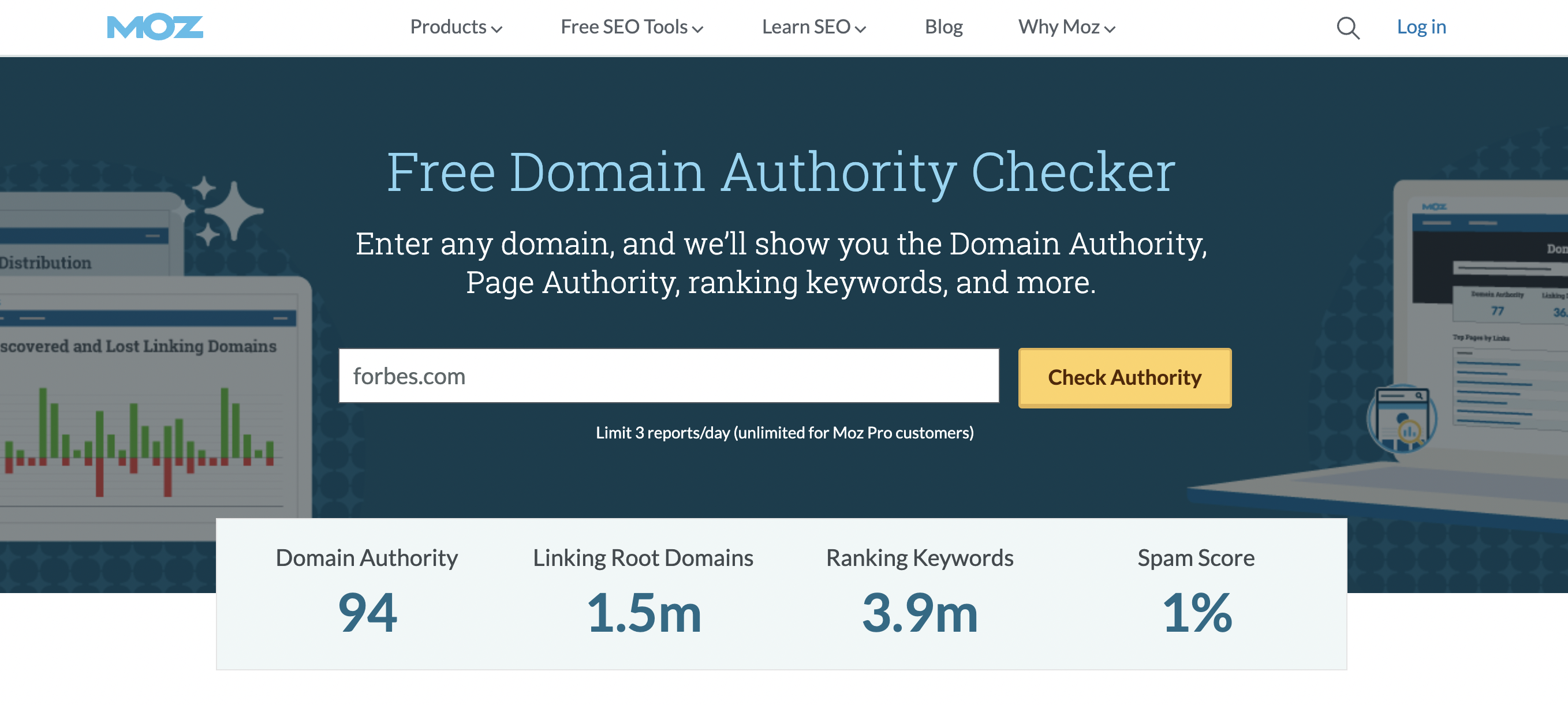
- Any site that has a Domain Authority (DA) of 70 or higher. Use tools like Moz.com to see the DA score of a website. For example, Forbes.com has a domain authority of 94:
- Is relevant — The more relevant the page/site, the more SEO “juice” it gives you with a backlink. For example, getting a backlink from Realtor.com would be great “juice.”
- Has quality traffic — Hard to measure without tools, but backlink from a site that actually has users and quality visitors is a good quality backlink (Google can see if the site is just a “link farming” site where it’s only goal is to bring traffic (no matter the quality or intent of the traffic) for backlinks.
The more of these higher-quality links you get, the higher your Domain Authority score. The higher your domain authority, the more Google trusts you enough to rank you high.
How to get backlinks
If you’re saying, “Well that’s great, but HOW do I get a link to my website from a quality site like Forbes?”
Well, that’s where a backlink strategy comes in handy.
All the websites we analyzed have intentional backlink strategies.
Here’s a guide on creating your own backlink strategy.
Here are a few ways to create your backlink strategy:
- Local Citations: Get listed in local directories to boost online presence and local SEO — here’s a guide on gathering local citations.
- Use HARO: Sign up for HARO (Help a Reporter Out) to get quoted by journalists and earn backlinks.
- Become a Local Expert: Offer free consultations, host seminars, contribute to local charities, and participate in community events to build authority. For example, you are a part of your local REIA.
- Share-worthy Content Creation: Regularly publish highly valuable content that makes others want to link back to your website. This could be controversial content, data, guides, or newsworthy pieces. In SEO this is referred to as link bait.
- Guest Blogging: Write guest posts on relevant websites to gain backlinks and exposure.
- Broken Link Building: Find and replace broken links on other sites with links to your content.
- #Journorequest: Use this Twitter hashtag to find journalists seeking expert contributions.
Top-ranking sites typically hire agencies or have an in-house marketing team to gather monthly backlinks.
6) Testimonials
Every top-ranking site had testimonials. Google wants to ensure that it only sends its users to trusted sources. And the more natural testimonials you have, the more trusted you look. It didn’t matter if it was only text testimonials or videos, as long as you have a specific place where you house the testimonials.
At Carrot, we make getting testimonials on your website incredibly easy via our Testimonial Page.
Here are some tips for gathering your testimonials:
- Call back old sellers/clients and ask — It doesn’t hurt to call back the old sellers/clients and ask them about their experience and if they can give you a review.
- Gather both text and video — you can ask for both from the same person to double up the content.
- Add it to your process — Make sure that every time a deal is complete, you have it as part of your process to ask for a review/testimonial.
- Include a drip—One of our go-to copywriters and the founder of OmniDrip adds a drip sequence for his clients that asks for reviews and referrals.
- Ask for a Google review—If they’re willing to give you a review, ask them to leave stars and a review on your Google page.
Create a case study — Case studies can be a part of your content strategy to showcase social proof. Create a case study for every time you get permission to share a review/testimonial.
7) Have quality, authoritative content
The last piece of the puzzle, but the most important piece, is content.
Google has gotten really good at recognizing what good, trusted content looks like. The top sites all had very high “EEAT” scores (all above a “B”).
What’s an EEAT score?
An EEAT score stands for Experience, Expertise, Authoritativeness, and Trustworthiness. It’s basically a measure of the quality and trustworthiness of the content. It’s a framework used by Google to assess the quality of content and its creators. Here’s a breakdown of what they look for:
- Experience: The site demonstrates first-hand involvement or personal experience in the subject matter.
- Expertise: Shows a high level of knowledge or skill in a specific area.
- Authoritativeness: Reflects recognition from others as a leading source of information.
- Trustworthiness: Indicates reliability and accuracy, often bolstered by transparent practices and verified credentials.
How to increase your EEAT
Want to increase yours? Simply follow steps 1-6 in this article.
By simply following these steps already laid out for you above, you’ll naturally increase your EEAT score in Google’s eyes. Let me summarize it:
- Have details and a custom “about” page
- Use location pages
- Have videos
- Use lots of organic keywords via authoritative blogs
- Gather quality backlinks
- Have testimonials
By following these steps, you’ll quickly raise your trust in Google’s eyes and start ranking in your competitive market.
Conclusion: Unlock Your Real Estate Domination with Carrot Websites
To rank higher on Google and attract more qualified leads, you should focus your efforts on creating valuable and relevant content, building high-quality backlinks, and ensuring your site showcases your credibility & expertise.
And of course, do this on a platform that is SEO-optimized, has the tools to help you get all of this done in a fraction of the time, and is proven to get more #1 rankings than any other website provider in our industry, even against custom websites.
Hopefully, this gives you a clear roadmap to outrank your competition and generate more motivated leads through SEO.
We know that implementing these strategies takes time and expertise. Ranking #1 takes work. That’s why our platform and the team that comes with it are here to help you every step of the way.
Carrot websites are specifically designed to help real estate investors like you achieve top rankings and dominate their local markets. Our platform integrates all the SEO best practices you just learned, including:
- Customizable About Pages: Showcase your expertise and build trust with prospects.
- Automated Location Pages: Capture leads in every city and neighborhood you serve.
- Seamless Video Integration: Engage visitors and establish yourself as a local authority.
- Built-in SEO Optimization Tools: Optimize your content for organic keywords and maximize search engine visibility.
- Backlink Tracking: Learn how to attract & analyze high-quality backlinks that boost your domain authority.
- Testimonial Management System: Showcase positive client experiences and build trust easily.
- High-Quality, Authoritative Content: Access a library of proven content templates and writing guides.
Ready to gain a trusted partner in your SEO efforts and start attracting more highly motivated sellers?
Get a free Carrot website demo today and see how we can help you stop losing deals to an underperforming website!

 When an entrepreneur with a family and a full-time, W-2 job says he’s “busy,” that’s an understatement.