“A LIFE WELL LIVED IS WHEN WE LOOK BACK AND SAY, “YOU KNOW WHAT, I DID LIFE RIGHT… I DIDN’T LOVE HALFWAY AND I DIDN’T LIVE HALFWAY… WHAT I DID MATTERED”Trevor Mauch
Ralph Waldo Emerson said, “Life is a journey, not a destination” – but more times than not, our journies get complicated.
How do we structure our lives to have more passion and fulfillment? To have more time for family and friends? What do you do? How does it happen?
On this episode of the CarrotCast, Trevor dives deep into where and why he’s at this period in his life and his business. Why and where he needs to build, change and delegate so he can continue to do the things that make his heart sing. Things we can all relate to in our own lives.
Especially in the makeup of entrepreneurs and business leaders, we all come to a chasm that we need to cross. But… that chasm seems like it’s a mile wide and a mile deep. So, how do we organize ourselves to overcome obstacles?
Find out and enjoy this conversation as he walks you through the mental operating systemmindset shifts you really need to explore and implement before choosing to cross that chasm you might be facing right now in your business or personal life.
Listen to this episode of the CarrotCast and start thinking about what’s really important in your life. Is it really to kill yourself from stress and selfishness? Or, is it creating a life full of strong relationships, fun and joy?
1:30 – Falling into the chasm of not enjoying life and hustling to make the next deal. 3:30 – New Carrot team members and brief Carrot retreat recap. What we do to plan and have fun. 10:10 – The chasm that you must go through of being “busy” to being “intentional”. 12:40 – Have a major mindset shift on your outlook on family, friendship, finances, fitness, and faith. 15:50 – How important it is to accelerate the important things in your life. 21:00 – Shifting into a new work week strategy to free up more time to spend with family. 23:15 – How to create your STOP DOING list. Stop doing or trim the things you’re not passionate about. 24:25 – Hire people to take care of the aspects of your business that you don’t enjoy. 10X your productivity. 31:50 – Finding a specific solution to specific problems you have not only in business but also in life. Move into your dream role. 33:50 –Plan strategic growth to regain more time in your life. 37:35 – What are you doing to change your mental operating system? 39:30 – The importance of investing in the things that are important to you. Get those 4 or 5 F’s (family, friendship, finances, fitness, and faith) in front you and rate yourself on a 1-10 scale.
Frustrated by the slow drip of leads? As a real estate investor, you know time is money. Waiting months for a trickle of potential deals can seriously hinder your growth.
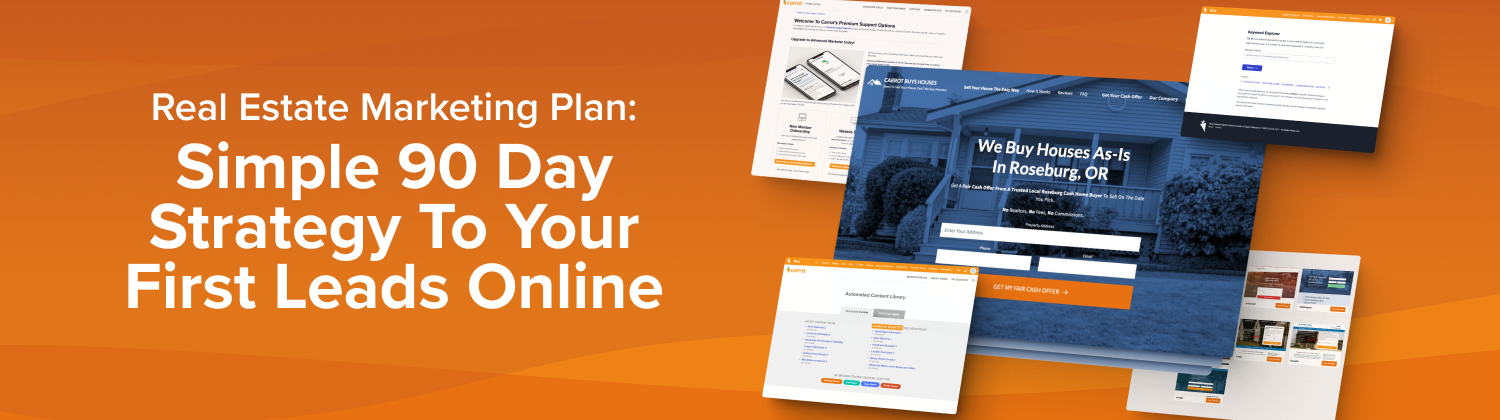
This blog post is key to unlocking leads in just 90 days. We’ll unveil a data-driven real estate marketing plan designed for 2024, helping you attract motivated sellers and generate more deals faster.
Demo Carrot: How many deals are you losing to your competitor’s website?
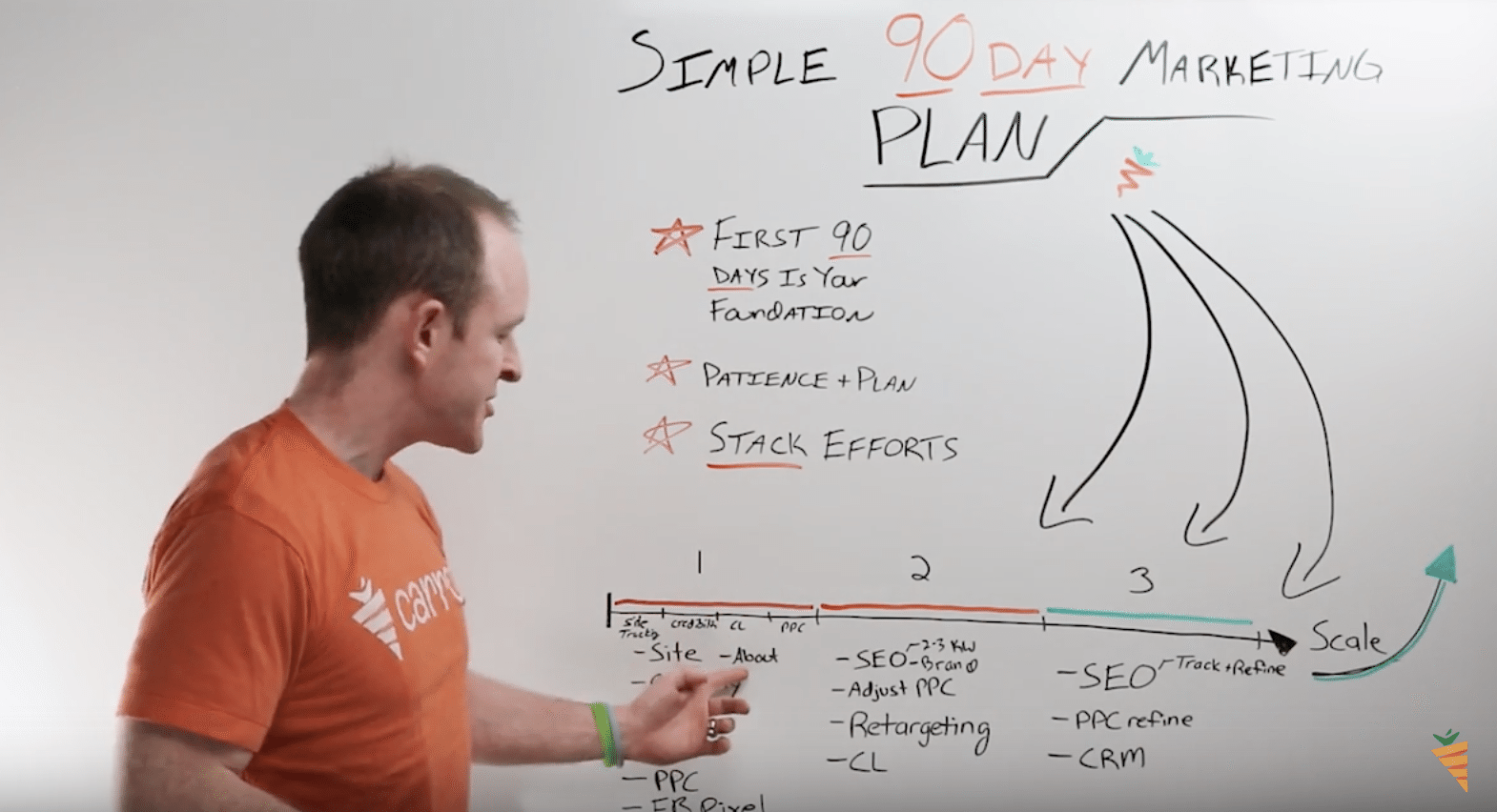
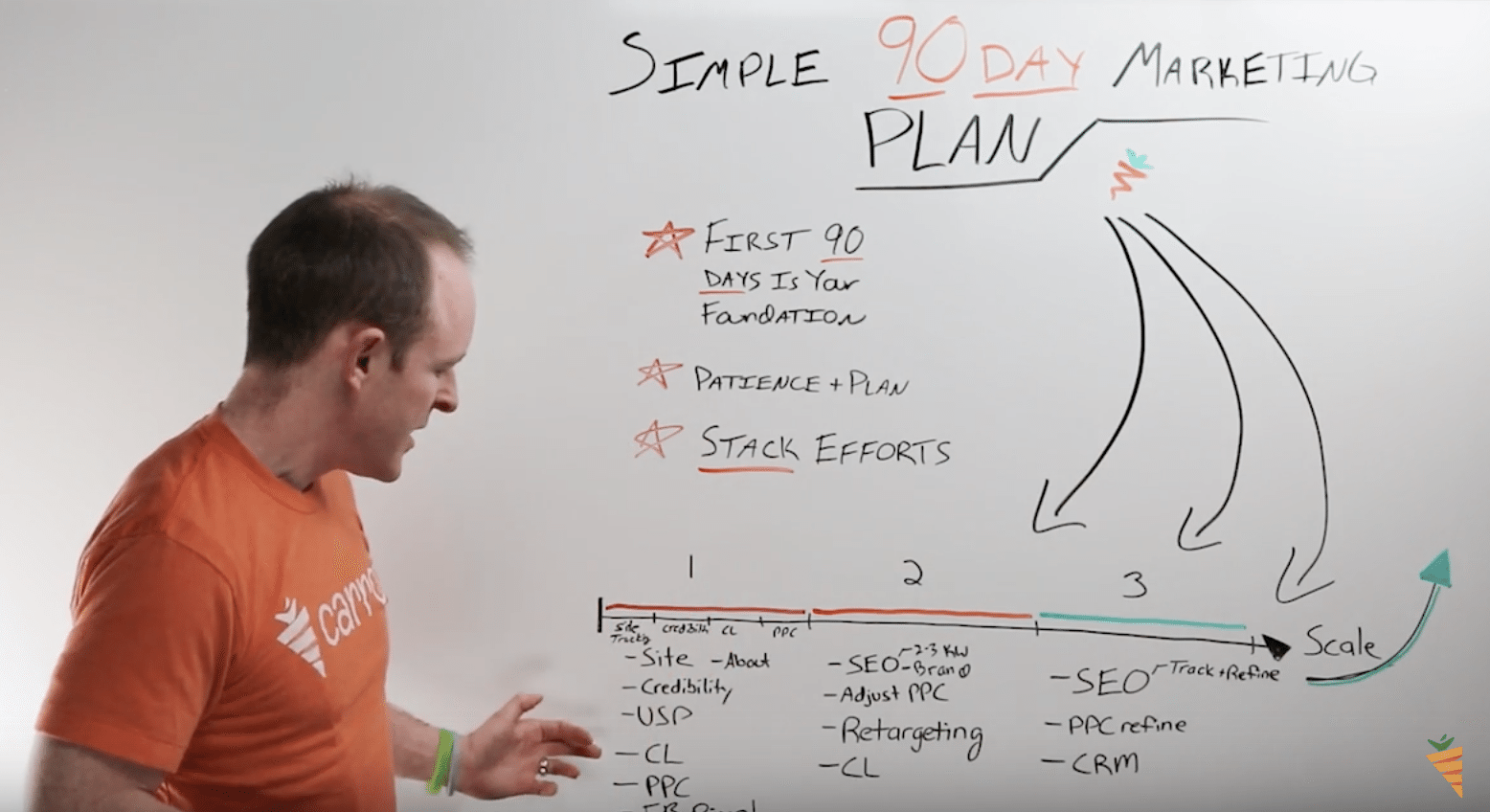
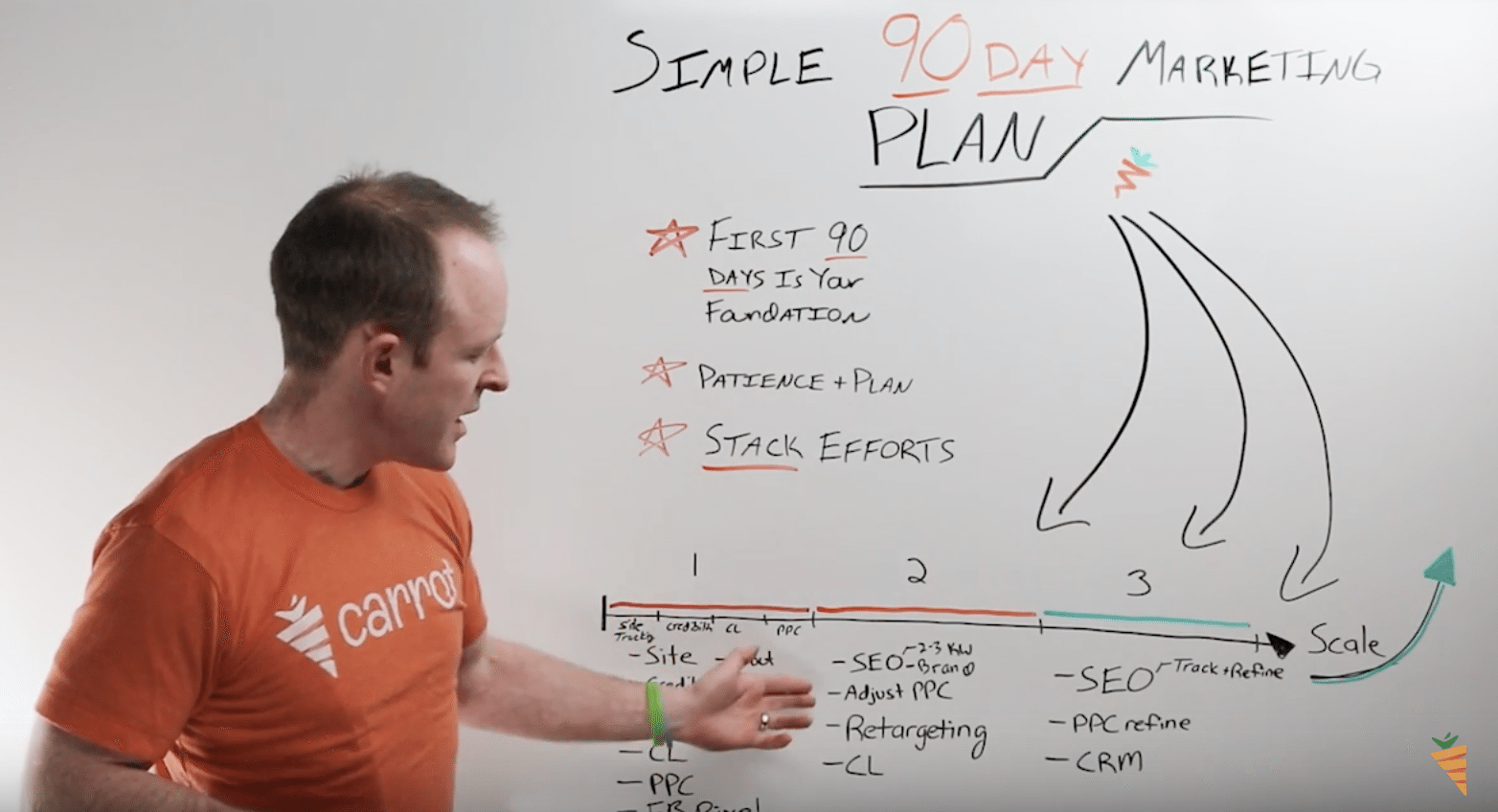
We all had it at one point, and you’ll probably have it if you don’t have it right now. I will walk through this Carrot whiteboard strategy, a suggested path in your first 90 days with your online marketing strategy in the real estate industry.
Real Estate Marketing Plan: Our Simple 90-Day Lead Generation Strategy For Sellers and Buyers
If you haven’t set up your website yet, the first thing you’ll do is, of course, get one. If you need a website, check us out at testcarrot.xyz. If you’re not a Carrot member, you can also check out biggerpockets.com or Facebook forums to see how our clients perform. That’s great! We’ll roll with whatever you have going on now.
The first 90 days are the foundation. So, many people have unreal expectations in their first 90 days of any marketing, but primarily online.
Online marketing takes some time to develop, so if you’re looking at SEO, PPC, or something similar, your first 30 days, especially, are spent getting things going and refining things.
Even if you’re doing PPC, your campaign won’t be optimized in that first month. So, have realistic expectations about your first 90 days. This is your foundation setup, and you will scale up after that.
One of the biggest things is you need to have patience in these first 90 days because if we expect the world to change in 90 days, you expect a flood of leads to start coming in, but you’re not putting a flood of marketing out there; then you’re probably not going to get the results that you expect.
I’m not saying that you can’t get a flood of leads in the first 90 days; you totally can, but you have to put a flood of marketing out there to capture that, and we’ll show you how to do that.
So, one thing I want to ensure that we all do in our marketing and our businesses is to keep your marketing simple initially. You see many different marketing methods and must explore them all at once.
But that isn’t the path you need to follow. We’ll often look at companies and go, “Man, that company is exactly where I want to be,” but they didn’t start there. They slowly stacked things onto their business, and over time, as they found out something worked, they made it good; they made a process. They systemized it and said, “Let’s stack something else on there.”
That’s how a real estate investor goes from doing their first deal to 2,000 deals. It doesn’t happen overnight. It happens by stacking marketing methods and systems, one by one, as they perfect each of them. So have patience and stack your efforts.
Conquer Online Marketing in 90 Days: Start with a High-Converting Website on Carrot.com
Forget chasing trends or endless social media strategies. Here’s a fact: Your website is the foundation of your online marketing success.
That’s why experts recommend launching a high-converting website as the first step in your online marketing journey. But building a website can feel overwhelming. Don’t worry, Carrot is here to help!
Here’s how Carrot makes creating a powerful website fast and easy:
1. Choose Your Winning Template:
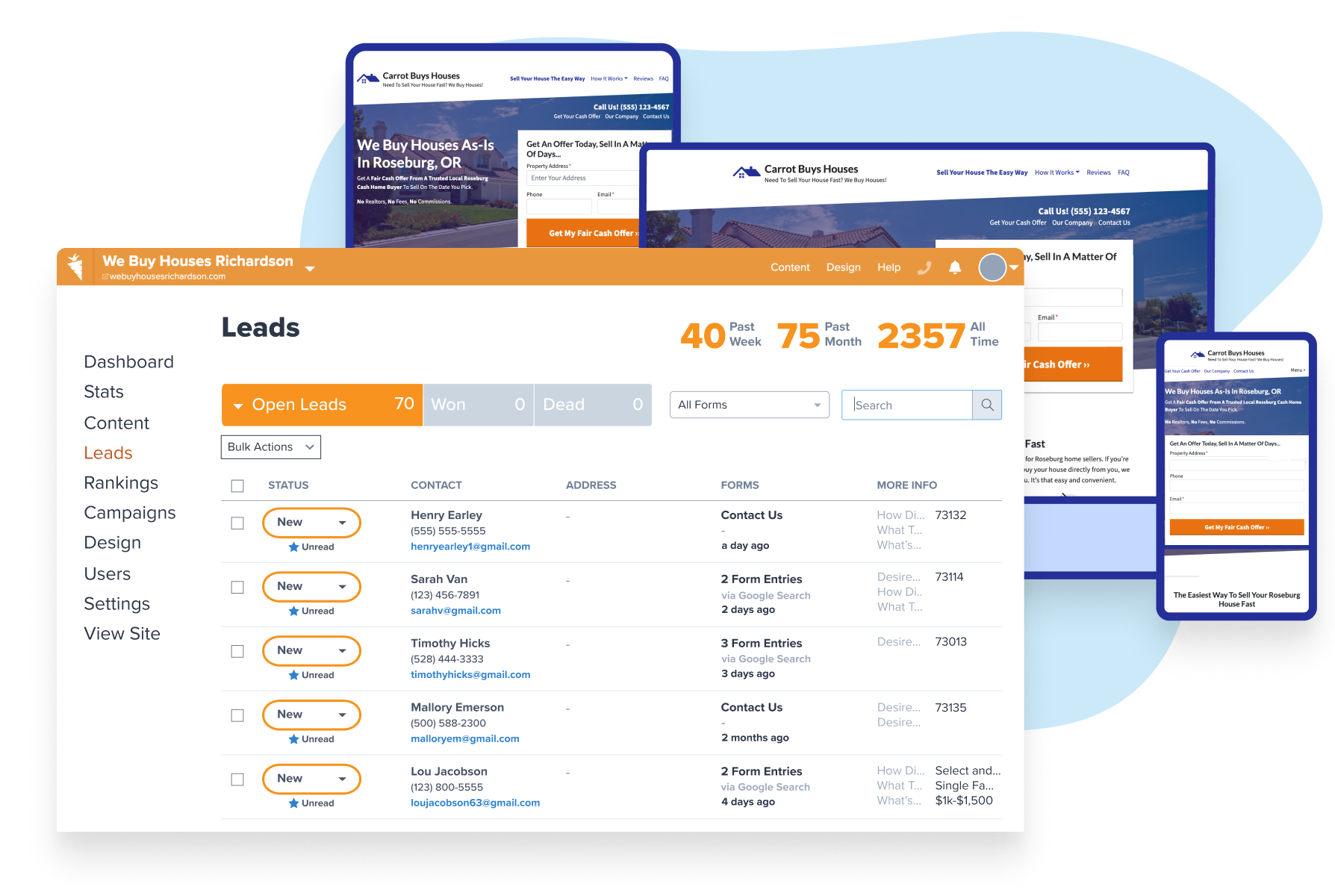
Carrot offers a variety of website templates designed specifically for real estate investors, each optimized for mobile responsiveness and high conversion rates. No hosting or coding necessary!
2. Customize Your Brand:
Make your website your own with a user-friendly editor. Add your logo, colors, and images to create a professional and cohesive brand experience.
3. Leverage Built-In Marketing Tools:
Carrot equips you with powerful tools like lead capture forms, call-to-action buttons, content tools, and SEO optimization to attract and convert leads from day one.
4. Focus on What Matters Most:
Carrot websites are designed to prioritize clarity and user experience. This means your visitors can easily find the information they need and take action, maximizing lead generation.
Stop wasting time on online marketing that doesn’t deliver results. Get started with Carrot today and launch a website that converts visitors into leads and fuels your online success.
Ready to dominate your online presence? Head over to Carrot.com and get started on building your high-converting website in minutes!
Personalizing Your Website To Cut Through The Clutter
Within the first 48 hours, you will want to do some basic stuff. Launch your site, tweak your content, personalize your content a little bit, post your story, and fill out your “about” page so people can connect with you.
You want visitors to see a real face or person behind the brand, not a nameless, baseless entity. As we’ve discussed in content, in our CarrotCast podcasts, and in our coaching calls for our customers, it’s a cluttered market. Hence, you stand out by telling your stories and connecting personally.
So, ensure you personalize your content within the first few days of launching your website. You have to reinvent the wheel. If you’re a Carrot customer, take our content and look at one paragraph, read it, see what’s in it, write it in your own words, and then delete ours. So adjust 20, 30, and 40% of that content.
Add Lead Tracking So You Know What’s Working And What’s Not
The next thing you must do is put tracking in place as soon as possible. If you’re a Carrot customer, you already have tracking in place, but if you want to get more advanced, and you want to use your own Google Analytics account, or you want to put your Facebook pixel, I would do that the first couple weeks of getting your website. Or, we can do it for you if you’re a Carrot member.
You’re going to need to start tracking that traffic right away. That way, you can begin to retarget people.
Hone Your Unique Selling Proposition
Next, you must ensure your unique selling proposition is nailed within those first few weeks of your online marketing.
What about you and your company standing out, giving people a reason to work with you?
Find Leads With Facebook Ads – First 30 Days
So we launched the website, got our tracking in place, personalized some content, had our “about” page up there, put a picture of you on there, and swapped out pictures. Hence, they’re local to your area, swapped out some content, so it’s unique to you and your area, and built-in that credibility, testimonials, things like that, and then we start some Facebook Ads.
Start Facebook Ads a week two or three after launching your website.
Facebook is fast, quick, and free. If you do it correctly, you can have leads and traffic coming in that day. Our blog has some great resources and a Facebook Masterclass.
Start by running a couple of ads targeting a motivated seller audience, then scale it up over four to six weeks to where you have a couple of campaigns with 3-5 ads within each.
Launch And Build Up Your Pay-Per-Click – First 30-60 Days
Next, once some Facebook Ads are going, your website is optimized with great content, you’ve personalized it, you’ve built credibility, and you’ve built a great “about” page, then you start to do some Google Ads if you have a budget.
If you have $500 to $3000 monthly and are in specific markets, you can start some small-scale PPC marketing and ramp it up.
Sprinkle Credibility Into Your Real Estate Marketing Plan
In month two, you have some momentum going. You’ve got your website; you can always tweak it later, add more credibility, or add your Better Business Bureau logo later. We always look for progress, not perfection, so get that site out the door in the first two weeks, build some basic credibility there, and then continually refine it from there.
If you’re unsure what to do on your website to build credibility, contact us or check out our content on credibility building.
Time To Work In SEO – 30-90 Days
Shift your focus to SEO and Evergreen Marketing. Pick two to three high-leverage keywords to focus on for your market. We discuss it in some of our resources and start setting that foundation.
Then, if you have a tool to track your rankings, maybe start putting those keywords in there to see how your rankings are going. We have that built into Carrot, but other tools can track your rankings if you’re not a Carrot user.
One of the biggest contributors to SEO is content. Ensure you have a good blog post strategy and plenty of real estate blog post ideas to work from!
Begin To Adjust Your Pay-Per-Clicks
Now, it’s time to adjust your PPC because you can’t set it up, forget it, and not adjust it. So, in month two, you will adjust and refine your PPC campaign. If you have enough traffic, you will also turn on retargeting.
You’ve put your Facebook retargeting pixel on, which we teach you how to do in a blog post on our website. Then, in month two or three, we will start turning on retargeting ads on Facebook, and the same thing happens: we teach you how to do those in those other resources, so check them out. Also, keep your Facebook Ads going.
Finally, to wrap out your foundational first 90 days, you’re going to be tracking and refining your SEO. You’re going to a coach or someone you can go to to ask them for advice on improving your SEO, building some backlinks, and social media signals, and this time, you’re probably going to get some citations.
So, get your website listed on Yelp, Yellow Pages, and all those citations. We suggest starting between 20 and 40 in the first 90 days. We can do it if you’re a Carrot member; check out our marketplace. If you’re not a member, check out our how-to build citations for real estate blog post.
After you refine your PPC, and only at this time, start thinking about a CRM. Way too many people started thinking about a CRM for tracking their leads in month one. If you don’t have any leads coming in, you have no leads to manage in a CRM. It’s like having gas without a car to put it into.
So make sure you’re focusing on getting leads first, and then you get your CRM to manage your leads once you start getting enough lead flow that you can’t manage. If you do it correctly, you scale up.
Wrapping Up Your Real Estate Marketing Plan: First 90 Days
Once again, contact us for those resources if you are a Carrot member. It’s just a quick run-through. We have many other resources, coaching, and guidance to help you crush it, just like we do with thousands of customers. If you’re not a Carrot member, keep returning to our CarrotCasts or free resources to help you grow or join the fold. Join the Carrot community.
We will be learning new, amazing things every week with great experts, great marketers, and our Carrot team to teach you how we do what we do and how you can make a bigger difference!
If there is something you want to do, the best way to go about and have that is to find people that are doing what you want to do. Follow them, shadow them, work with them and that speeds up the learning curve tremendously. Doug Fath
How do you find out what you’re unique ability is so you can live the life you want? Learn some actionable lifestyle and investing tips from a successful real estate entrepreneur and build a business you’re truly passionate about.
Doug Fath is one of the couple dozen people in my “inner circle”. Entrepreneurs I’ve known for years, we’ve grown together, get together in person a couple times a year in a mastermind I started with my former business partner Patrick Riddle.
Doug is an amazing real estate investor who started with student housing in Philly, transitioned into repositioning rental portfolios, development, and now owns a hard money / private lending company alongside his other real estate businesses.
Doug is truly an entrepreneur who is grounded and has found his “Wealthy Passion”. Listen to his story on how he got started in real estate investing and what led to his success.
Doug Fath of Legacy Capital in Philadelphia joins Trevor on this episode of the CarrotCast. Listen as they discuss investing in student housing, hard money lending, finding your unique ability in life and much much more. Enjoy!
2:00 – How certain events have changed Doug’s priority matrix and what the purpose of entrepreneurship is in his life. 6:40 – What his development and private lending business structure look like. 11:30 – How setting the right goals and being highly intentional has changed his life. 12:35 – From sports apparel to real estate investing. How Doug got his start and a couple of key decisions he made. 16:40 – How he stumbled into investing in student housing and how to protect yourself if you investing in this type of real estate. 20:00 – The transition into true apartment rentals and the resurrecting a warehouse in Philly into family units. 24:05 – The psychological side of owning a lending company and working with partners. 28:20 – How he identified and was able to help solve problems many real estate investors were having in their business. 34:05 – Why it’s important to find your unique ability. Spend more time on the things you’re good at and that you love to do. 42:20 – The 3 key phases to finding the right partnerships so you can achieve what you want to do. 47:45 – Before diving into a partnership – take the Kolbe personality test! Be sure to know how compatible you are with your partner. 51:00 – Why it was a good moving to add hard money lending to his professional portfolio. 54:55 – What type of mindset it takes to position your company above the competition. 58:50 – Doug’s #1 growth priority. 1:00:22 – His biggest takeaway from attending the Berkshire Hathaway annual meeting.
Your first month of online marketing typically is going to be one of your hardest and least productive because you’re really cutting new trail everywhere you go. Kiley Newbold
If you haven’t been running Facebook ads for real estate lead generation, then you’re most likely missing out and stepping behind your competition.
Getting motivated house seller leads on Facebook hasn’t been easy over the years. Cash buyers, tenants… yes. But sellers have been a harder nut to crack. Until the last 12 months, that is.
Our guest, Kiley Newbold, a Facebook marketing ninja who was the Vice President of Marketing & Technology at a $75MM company before going full-time into Facebook marketing for real estate professionals recently, dives into his strategies that are consistently attracting high value motivated house seller leads through Facebook ads.
Listen to this episode of the CarrotCast with Kiley as he lays out some Facebook marketing tips for real estate investors and agents. Grab something to take notes and take full advantage of these tips. Enjoy!
3:30 – How Kiley helped build the ColorRun from 0-50 countries and helped millions of people via Facebook. 7:25 – Why working and the time spent with the ColorRun was so enjoyable. 10:15 – How Kiley is bringing his passion from the ColorRun to his new business venture and entrepreneurship. 12:35 – Why Facebook hasn’t worked for motivated seller leads in the past and Facebook marketing pitfall #1. 18:16 – Taking the emotion out of your advertising decisions and instead trusting your data. Carrot ROI Tool. 20:40 – How to set your advertising budget. 21:45 – Facebook marketing pitfall #2: Don’t look at your numbers on a daily basis. 23:25 – Facebook marketing pitfall #3:Testing too many variables at once. 26:18 – Facebook marketing pitfall #4: Don’t make massive changes on a regular basis. 29:50 – How much does the actual website play into the success of Facebook campaigns and why having a personalized website makes a positive effect. 36:30 – Why it is so important to have not just a mobile friendly website, but also one that is optimized to convert while you’re using Facebook marketing. 37:10 – What first step you need to take when structuring your Facebook campaign. 39:05 – What types of ads (image, carousel, video) are working best right now. 43:50 – Quick Facebook marketing tips for real estate recap. 47:00 – The importance of retargeting and how to get it setup. 49:15 – What Kiley has seen as the biggest difference in markets. Are there markets where Facebook hasn’t worked? 50:05 – What statistics and numbers you should be concentrating on and the importance of understanding attribution. 57:00 – Take these Facebook marketing tips for real estate and apply them to the places where people hang out the most. 58:20 – Kiley’s current journey into entrepreneurship.
During times when the real estate marketing is going good, don’t lose your focus on the business fundamentals. Feasting and blindly following a business path can lead to destruction. Trevor Mauch
From cluttered markets to video advertising, here are some real estate lead generation challenges we think you should know in 2017.
2016 flew by and lots of changes happened in the online marketing landscape for real estate investors. Google made some big SEO updates, AdWords updates, mobile continues to climb in importance… and the real estate market is shifting.
What are our CEO, Trevor Mauch’s, predictions for 2017 and how real estate investors and agents will HAVE TO SHIFT in order to crack through the clutter of competition in your area?
Listen in for Trevor’s 4 real estate lead generation predictions that could help you gain an advantage in your marketplace online.
3:50 – Prediction 1: Shifting in the market. Follow business fundamentals. 9:20 – The shift from investors to agents. 10:22 – Prediction 2: The market will get cluttered in 2017. How do you stand out from your competition? 11:25 – Riding the mobile wave. In 2016, 56% of all online leads on the Carrot platform came in via mobile/tablet. Two years ago, that number was in the mid-40% and 2015 teetering right around 50%. Where will it be in 2017? 15:30 – Prediction 3: Mobile. Why having a mobile-friendly site just isn’t good enough anymore. Your website must be optimized for lead generation. 16:45 – The 2016 AdWords updates and the indication of where Google is going in 2017. 17:50 – Focusing 100% on setting up a mobile website advantage. Especially on Facebook. 22:00 – Prediction 4: Marketplace competition bottleneck.How to cut through your market clutter. Especially utilizing video marketing. Using video to sell your listings, generate more leads, and attract new clients. 34:35 – What you should be doing with video, Facebook, and YouTube. 36:30 – Nailing your niche real estate content. 38:14 – How to put yourself in the “Content Always” mindset. 39:25 – What is going to happen with motivated house sellers? 40:15 – Adjusting your marketing message to suit the current market state.
Need a little help planning out your year? Listen to our annual planning call and get Trevor’s exact process to plan and crush the year ahead. Visit:ontestcarrot.xyz/epic/replay
No one made you go into debt. It was nobody’s fault other than yours. So that has to be fixed before you can start investing. You need to get out of debt and you need to be able to control where you are now. Adrian Nez
92 percent of people who set goals never achieve them! How do you break yourself from the populous and avoid what may be derailing your goals?
Average people tend to fall prey to these 8 goal killers more often than high performers. What about you?
Will you derail your goals this next year?
Will you have a process to notice and jump over these 8 goal killers when they come into your path?
Adrian Nez and Trevor Mauch from the Carrot team discuss the 8 goal killers, how and where they pop up in our lives, how to get past them quickly (or avoid them all together), and what struggles they’re going through in their own lives as entrepreneurs growing 6 and multiple 7 figure companies.
This could change your entire year ahead if you avoid just one of these common goal killers.
Stop sabotaging your personal and business life. Listen to this episode of the CarrotCast with Trevor and Adrain to get that knowledge and mindset for positive change.
4:40 – Taking a look at what derails a lot of entrepreneurs.
8 Ways To Kill Your Goals And How To Fix Them
5:30 – Derailment 1: Not having an established routine. How to fix your routine to stay on track. 10:10 – Derailment 2:Focusing on the wrong things. Learn how to identify symptoms and what the root causes are so you can fix them. 19:40 – Learning how to think accurately before thinking big. 26:10 –Derailment 3:Failing to schedule quiet time to reflect upon and organize your life. 35:25 –Derailment 4: One of the biggest derailers – Shiny object syndrome. Chasing that next best thing before you have given something else time to establish. 46:45 – Derailment 5: Lacking the “why” in your goals. If you don’t know why you’re doing something, you’re setting yourself up to fail. 55:40 – Derailment 6:Failing to plan. How many hours have you been on Facebook or watching TV vs. how many hours have you spent planning out your next year? 1:05:05 – Derailment 7: Doing everything yourself. Learn why it’s so important to delegate certain tasks in your job. 1:09:25 –Derailment 8: Not setting your body and mind up to perform at a high level.
Content is not a single player sport. If you’re doing it alone… You’re doing it wrong.Aaron Orendorff
On this CarrotCast, Aaron Orendorff of iconiContent, doses out actionable advice and tools for investors and agents looking to improve their real estate content marketing campaigns in the year ahead.
How do you achieve quick business growth? One of the main ways is giving your audience high-value content.
But, how do you use content marketing correctly? How do you do it to where it actually builds value into your business to bring you the clients you need?
As a real estate investor, how do you create content that cuts through the clutter in your market, so you stand out as the expert?
At Carrot, we write and craft the content that builds credibility and achieves higher rankings in Google. We create evergreen content that will rank well for months or even years.
How would you love to create content today or this week or this month that brings you the leads for months or years to come?
On this episode of the CarrotCast, we’re joined by one of the top SEO, conversion, and content marketers in the U.S., if not the world.
Aaron Orendorff is going to make your life easier by giving you some content marketing ideas for real estate that you can use in your business to create content that breaks you free from the market and places you steps ahead of your competition.
Listen to the Podcast
[podcast-subscribe]
Listen to this CarrotCast with world-renowned content marketer Aaron Orendorff…
4:30 – Aaron’s unconventional journey into content marketing. 7:30 – Why content marketing is so powerful and the importance of getting outside the “bubble” when creating your real estate content strategy. 10:20 – Trevor’s content background, path, and strategy. 12:25 – Aaron’s 3 part process for managing content. 15:05 –How to generate content marketing ideas for real estate. 17:00 – What online resources Aaron, and you can too, uses to write real estate content. 19:25 – Using Buzzsumo to come up with really strong real estate content ideas. 22:15 – Online tools that Carrot uses for topic and keyword research. 23:45 – Where to find quality writers so you can delegate your workload. 26:00 – Aaron’s 4 step process for laying out the structure for a piece of content. 31:25 – Why you need to come up with your own content marketing pillars; such as, video content or skyscraper posts. 34:00 – How to repurpose your content and why it’s such a valuable option. 41:10 – Carrot’s simple repurposing structure. 44:25 – Why it’s important to choose one type of content to produce when you’re first starting out with your real estate content. 46:45 – Aaron dishes out some advice for processes and systems for beginning content creators.
Aaron Orendorff is the Head of Marketing at Recart — an SMS platform helping ecommerce businesses grow through text-message marketing. Previously the Editor in Chief of Shopify Plus, his content has appeared on Forbes, Mashable, Entrepreneur, Business Insider, The New York Times, and more.
I love telling people “day one we did one house.” There wasn’t this whiteboard masterplan to do something. It was just…”Let’s go buy a house, make some money off of it, offer a service on it, and then we’ll do number two.” Chris Clothier
Do you know the secret to a thriving business? It’s not competitive pricing or a major marketing campaign.
The secret to a successful business is building and fostering healthy relationships.
You MUST build and care about the relationships you have with your employees, your suppliers, your contacts, and most of all, your customers. This leads into…
What does it take to grow a $100M/yr real estate empire and buy 15 houses per week… all while growing an amazing culture and team that is massively impacting the world?
Well Chris Clothier, one of the owners of Memphis Invest, dives into his story, successes, and struggles.
We dive into specific things they did early on to stand out from other investors, specific things they do to build an amazing culture with their team members, and struggles he’s had along the way. Listen to our other episodes at the CarrotCast.
Listen to the Podcast
[podcast-subscribe]
Listen to this CarrotCast and find out the secret to what it takes to create a business model for real estate investment that generates $100M/yr.
4:05 – What a $100M/year company’s business model for real estate investment looks like. 6:20 – How Memphis Invest started. 9:50 – Memphis Invest is a family company built on having really high customer service values. Find out what they did before real estate investing and why they made the shift. 13:45 – Dealing with real estate market shifts. 16:15 – The importance of being fundamentally sound and sticking to your word. The difference between operating on a scarcity mindset or an abundance mindset. 19:00 – Finding a market to expand into that fits your criteria… not just buying houses. 22:50 – Why Chris follows a “do the one thing that others don’t want to do” approach. 26:25 – Why culture and experience are such big parts of their business model. 29:25 – It’s so important to create a set of core values and deliver WOW! 33:15 – Do you know the sign of a good leader? Find out what they look like within Memphis Invest. 35:05 – Examples of failure within leadership. 37:45 – How to build real relationships with your clients. 41:09 – Why it’s important to make real connections. 52:55 – Chris’s plans and goals heading into 2017.
How do some the top real estate investors plan for the next year?
Sometimes small differences separate those who fail in real estate vs. those who thrive… and the end of the year planning rituals give these top investors a huge edge over their competition.
What are you doing this time of the year to plan for a successful year ahead? Well, here’s a peek behind the scenes of what these top real estate investors do to hone their mindset and get laser focus for the year ahead.
Real estate investors continue to thrive by using solid real estate investment strategies. Wholesaling and flipping are continuing to push momentum as well as the multi-family market.
However, perhaps even more than ever, is the ability to adapt to move within the market trends is hugely important. The ability to plan ahead.
So we reached out to some top investors and real estate professionals to see if they would share what type of mindset they have when penciling in their strategies for the coming year.
Use these strategies below and implement them in your own business before you get too far into the new year!
5 Mindset Habits To Help Create Effective Real Estate Investing Goals For The Year Ahead AND Actually Achieve Them
I love doing end of the year planning for the upcoming year. In order to make this planning as efficient as possible, there are three things that set me up to hit the ground running to create my yearly goals.
1. Accurate Numbers
I have the books for over a dozen of my entities reconciled on a monthly basis (thank you MY HQ Pro) so by the time I get to December I have accurate numbers through the end of November. This is super important because you need to account for your current year goals before you can create new ones.
2. Strategic Planning
I’ve always been a big planner but Dan Sullivan’s Strategic Coach Program has helped me take strategic planning to a new level, so by the time I get to the end of the year, I already have a pretty good idea what I’m up against in the new year based on my previous written goals (Life Time Goals, 3-Year Goals, and 1-Year Goals) that I review on a quarterly basis.
3. Inspiration
There aren’t many authors that can do this but there is something about Robert Kiyosaki’s writings that speaks to my soul and gets me inspired.
I re-read and skim some of my favorite books which are primarily from his “Rich Dad” Collection.
I’ll go through my highlights of “Rich Dad Poor Dad”, “Cashflow Quadrant”, “Guide to Investing”, “Retire Young Retire Rich”, “Increase Your Financial IQ”, “Conspiracy of the Rich” and Keith Cunningham’s “Keys to The Vault” and “The Ultimate Blueprint for an Insanely Successful Business”.
By this point, I’m ready to rock and roll and create my new annual goals which I create in the following format.
Yearly Goals
Vision Board
Word of the year
Context – focus for the year
Business Investment Strategy (from Kiyosaki’s “Who Took My Money”)
Visual Illustration of my Business Investment Strategy
High-Level Goals – “Retire Young Retire Rich”
Personal Financial Statement – how do the fulfillment of my goals show up here
Personal Financial Statement – Results from the current year compared to new goals for the upcoming year
Growing & Development – “Rich Dad’s” 3 paths to wealth and how I plan to learn and grow in each of those areas this year
Financial Statements of Poor, Middle Class, and Rich (always a good reminder)
I think for any proper, true self-reflection, you need to be able to get away from your regular physical and work environment.
For me, that means going out of the country. At the end of each year, I try to take a trip to truly disconnect from my regular “world” and “grind” to assess where I’ve been and where I’m going.
[At the time of writing this] Right now, I am sitting on my balcony in Maui overlooking the Pacific Ocean. We got in last night after spending 11 days in Thailand. Both destinations have been sunny, peaceful, and idyllic which all offer great scenery for taking time out and really thinking about what’s important in life.
So that brings me to my year-end assessment and planning for the next year.
I ask myself these questions…
I think goal-setting has its place and I do some of that for the next year. But there is a deeper process that I engage in and it starts with asking myself the following questions:
Am I engaged in the kinds of activities every single day that I truly enjoy and want to be engaged in?
I think focusing on goals is important but I want to make sure I am enjoying life and my work every single day, not just the thought or the prospect of the prize at the end of the journey. So I try to make sure that my daily activities and my work involve things I am truly passionate about.
If you can get to that point, then the end result actually becomes less important. If you enjoy the journey, then the destination matters less and less.
I make a list of the high-level work I do all the way down to the daily routine stuff and if there are things on the list which I don’t truly enjoy doing, then I make a game plan for how to outsource or delegate more and more of it out.
And if there is an entire business or business segment which I realize doesn’t truly bring me satisfaction (I run multiple companies and within those companies multiple business niches or segments or revenue generators), then I start thinking about getting rid of that business or business segment altogether.
Am I living the kind of life I truly want to be living? This is more of a bigger picture lifestyle and lifestyle planning question.
Am I pursuing my passions?
Am I engaged in regular learning?
Am I traveling and seeing enough of the world?
Am I helping others regularly and giving back?
Again, I think it’s important to ensure that our life is designed according to our ideals right now, not someday later.
So I make sure that my plan for the following year includes all of these activities and if I don’t have the means to do something, then I make a game plan for finding those means.
Those are my starting point questions.
Once I answer those questions, then I back my way into what my specific goals and activities for next year should be so that I am able to continue leading the kind of life I want to be leading.
Those answers guide what I do, not some arbitrary revenue figures or goals that are rooted in someone else’s expectations of me.
Well, my friends, it’s that time of the year again. As we get ready to embark on another year, I’d like to share with you the process I go through to ensure I set myself up for success, and crush my goals!
I’m not talking just about setting goals, and I’m definitely not talking about “new years resolutions” (which completely suck in my opinion).
I think most people understand the importance of goals, but few people approach this important task with the level of thought and attention I think it deserves.
After all, how can you have what you want out of life and business if you don’t know “WHY” you want it? How can you stack the deck in your favor so that by this time next year, you’re feeling accomplished, successful, happy and fulfilled?
This post is aimed at helping you CRUSH IT (and my hope is that this process will help make it your best year ever!)
The following 9-step outline will walk you through my systematic approach to document my vision, my “why”, set the goals I will accomplish in the new year, as well as an action plan to help guide me along the way.
(Quick Tip: Did you notice what I said there? I said, “…set the goals I WILL accomplish”. You always want to state your goals as if you already achieved them)
Here we go:
1. Year-End Reflect & Review
Take out a legal pad of paper (you’ll use this a lot), and write down everything you accomplished this year. I often find that I accumulated many more “wins” than I thought, and this process will help you begin to appreciate the progress you made (even though you may not feel like it).
Now take some time to think about the challenges you encountered along the way. Write them down, but most importantly, write down what you learned as a result.
2. Focus on your “Wins”
Look at your list of accomplishments and focus on the positive. Don’t worry about the goals you didn’t accomplish, but look at where you were, and all the progress you made throughout the year.
It’s always more productive to focus your attention on the gap between where you were, and where you are now, opposed to focusing on what you weren’t able to accomplish!
3. Express Gratitude
Write down everything you are grateful for… do not let your hand stop, just let it flow! It’s amazing what expressing gratitude does in our lives, so make sure you adopt this practice on a daily basis!
4. “Cut the Fat”
Make a list of the things you don’t like doing, and/or don’t add value to your life/business, and decide if you can: Delegate it? Outsource It? Automate It? Or, completely remove it from your list?!
5. Write out your ‘January Letter’ (Vision)
I got this from my friend Sean Terry, and it’s a great exercise. Mentally fast forward to Dec. 31st of the following year, and ask yourself what would have had to happen in that year for you to feel happy, successful, accomplished, etc.?
Then write yourself a letter as if that year just finished and you accomplished everything you wanted to accomplish.
TIP: Make sure that you embed emotion into this exercise. Imagine what it would feel like after you’ve crushed your goals…
6. Create Emotionally Driven (S.M.A.R.T) Goals, and most importantly document your “WHY”
Document exactly what you want to accomplish in the coming year, and “WHY”. I like to focus on 1-3 goals max, and for the following categories:
(Each goal should have a quick sentence or paragraph on “WHY” you want this goal. Remember to write them down as if you already accomplished them!)
7. Reverse Engineer Your Goals
Break them down into quarterly goals
Then break those down into monthly goals
Then break those down into weekly goals
and finally daily goals
8. Set Your Calendar
Start with the most important thing first (ex. if Family, schedule all vacations, family time-off, etc…), then move on to the second most important thing (ex. Business goals). Everyone will be different, so you have to be self-aware.
What’s most important to you?
9. Recharge Your Batteries
Take some time off to do what you love. Think about what energizes you, and do that! You can’t imagine how beneficial this is for you, your family, and your business.
That’s it, my friends. I’ve come up with this throughout the years, and I hope you find it valuable. You are getting ready to do big things next year. People are relying on you, so follow through and make it happen!
Oh, and one last parting thought…
It’s not always about the destination, but the journey.
Make sure you enjoy the ride. It won’t always be smooth. In fact, I can almost guarantee it will be bumpy along the way, but it’s all part of the process in making you the best version of yourself!
Dan Schwartz
“The January Letter”
I didn’t originate this, but I can accredit it to Frank Kern for instilling this habit from a podcast I heard years ago.
The gist: Before NYE, write a letter as your future self. Date the letter exactly one year from today, and start it with something along the lines of “Dear [your name], it’s been one heck of a year!” followed by a description of your accomplishments in these four pillars of your life:
Personal development goals: Health, mindset, and relationships (new workout habits, new mentors, etc.)
Career/business/economic goals: What level of financial abundance you’d like to achieve, what person have you become in your field etc.?
Stuff goals:What kind of cool toys, trips, experiences, and fun stuff did you do and acquire?
Contribution:How have you given back to the world?
The point of the exercise is to mentally frame these accomplishments as if they already happened. It’s a powerful subconscious exercise.
You’ll find when you read this letter in a year, it’s usually eerily in line with what you were able to actually manifest…so dream big!
I’m talking… increase my income (net income, not just revenues) and productivity by 10x, I’m consistently happy (has nothing to do w/ the money by the way), fulfilled, clear on my purpose…
… and yes… I’m still busy. I haven’t slain that dragon yet…
… but the work I do for the most part now is stuff I LOVE to do and my purpose and mission in life have become crystal clear.
It’s all a process.
Anyone can repeat it.
It’s 4 basic steps (that I went into in detail this week in a live Google Hangout that you can see below.
The steps are…
1. Mindset Re-Set
It’s easy to lose urgency for actually doing the important things NOW in life vs. waiting and thinking we have forever to do it. Time with family, creating your legacy, striving for achievement, etc.
So I recognize my own mortality… that NOW is the time to do those important things since there’s no guarantee any of us will be here in 10 years.
2. Solid Annual Planning Process
I do a 2 day “off-site”… fully away from the office and away from distraction. For me, it’s with the Leadership team at Carrot and we basically go through this agenda (and have a lot of fun in the process).
Reflect and review the year behind us. What did we do great? Do not so great? Celebrate the wins!
Mind-expanding s*** (pardon the french). Let’s really think big. Allow ourselves to get scared a bit. Then peel it back to what we want to accomplish specifically the next year now that our mind is expanded. What impact do we want to make? What legacy can we create right now? Why are we here????
Product planning. What products/services do we need to have and improve the next year to march toward that big vision we just cast? Get specific.
Marketing planning. What kind of marketing will it take to sell our product/service to reach those goals? Be specific.
People planning. What gaps do we have currently or bottlenecks we need to solve to achieve all of that and still live the amazing lifestyle we want to live? Also what amazing people can we bring into our mission and how do we best enrich their lives?
Process planning. Are there any processes we NEED to have in place to do all of that better? There always are. What will really unleash you and your potential in 2021 process-wise? Be specific. Tackle those first in the next year.
3. Structure To Keep Course During The Year
Most people do goal setting once and then they never check them again. I’ve learned I have to have guard rails on my year to keep me on course. Chunk down your big goals to 90 days so they seem more achievable and are easier to turn into action items each month. Have a solid daily “to do” process, and put other things in place to keep you on track.
One great way to stay motivated, inspired, and on track is to surround yourself with things that inspire you.
So What Are You Doing To Plan A Successful Year Ahead RIGHT NOW?
As the old saying goes… “if you fail to plan, you plan to fail”.
The same thing doesn’t work for everyone as you can see in this blog post. So, borrow from what’s working for these top real estate entrepreneurs and implement those strategies in your own life right now.
My guess is less than 5% of everyone reading this will actually go out and thoroughly plan your year ahead. Those people will crush it.
The rest of the people will likely be looking back this time next year at the year that passed saying, “Man that year went fast. I had some goals I wrote down but I got off track and this year ended up just like last year ended. No real progress on my big life goals, no momentum, and nothing much to show for the year.
So it’s your choice… borrow from these best practices this year to plan an epic year ahead… or continue on with the status quo. I hope you choose to have a life-changing year (for the better) in 2021.
What are you doing to plan for 2021? Let me know below!