Author: Trevor Mauch

  • EP 17: He’s Bought 2,000+ Houses. How?  Brad Chandler with Express Homebuyers Unveils His Journey

    EP 17: He’s Bought 2,000+ Houses. How? Brad Chandler with Express Homebuyers Unveils His Journey

    2016-10-04-carrotcast_brad_main

    Our bread and butter was TV and has been for years. My father did TV advertising back in the early 80’s as an Attorney. In a way, he sort of pioneered it in the legal field. His two partners said “hey, I don’t want to do business with you if you’re going to TV advertise” and he said “see you later” and went and found two new partners. – Brad Chandler

    Why You Need A Killer Mindset In Your Real Estate Marketing And How Brad Has Thousands Of Reasons To Show For It

    Subscribe and rate us on iTunes

    Brad Chandler is the CEO of Express Homebuyers, one of the largest home buyers in the entire country. In this episode, we dive into what makes someone who has grown from a one-man show to now buying over 2,100 homes, tick.

    What key mindset shifts did Brad have to make early on? And what does Brad say is the most important part of his real estate marketing arsenal?

    Enjoy :-)


    Past CarrotCast episodes


    Listen to the Podcast

    Subscribe To The CarrotCast On iTunes

    In this CarrotCast conversation Trevor and Brad tackle: 

    • What makes high-achievers tick.
    • Differences in mindset between those who quit and those who find a way to figure it out.
    • Tips to stand out from your competition.
    • How to create an effective lead follow-up system.
    • How to create a business that serves you.

    Watch the Video Version

    He’s Bought 2,000+ Houses. How?  Brad Chandler with Express Home Buyers Unveils His Journey

    2:00 – The structure and focus of Express Homebuyers. From blow pops to 2,000 deals.
    5:35 – The three buckets of Express Homebuyers – Fix and Flip, Condo Development, and Rental Portfolio.
    7:00 – What it took to start Express Homebuyers and spending seven hard working months to close the first deal.
    8:50 – The difference in MINDSET between the people who struggle, but keep going and the people who quit.
    11:10 – The driving force behind Brad’s positive MINDSET.
    13:45 – Transactional vs. Wealth building wholesaling.
    15:20 – Brad’s real estate marketing plan – Heavy on TV advertising.
    20:10 – Standing out from the real estate competition, the value of being in front of your brand to build credibility, and the importance of your website’s “About” page.
    28:50 – Creating a business that serves you. Not you serving a business.
    35:25 – How to build an incredible follow-up system.
    40:10 – Implementing the 9 Word Email.
    42:20 – Outpacing the competition online. New Facebook targeting option.
    46:45 – Focusing on the “one thing” to strive to be better at.

    [podcast-subscribe]

  • 5 CarrotCast Episodes To Nail The Mindset Game

    5 CarrotCast Episodes To Nail The Mindset Game

    2016-10-07-carrotcast-roundup-main

    Believe it or not, I didn’t want to do podcasts. I thought I wouldn’t have enough time. In fact, I didn’t think anyone would listen and it would be a total failure. Well, podcast listening grew 23% between 2015 and 2016 so it was time to climb aboard. And, I’m glad I did.

    I’m super excited about how the CarrotCast has started out and where it’s going in the future. We’ve already had some amazing guests on the show who have intrigued our audience with some amazing conversations.

    Not only have we been able to dive into some phenomenal real estate content, but also, building positive mindsets, effective copywriting skills, hiring and delegating processes, invaluable marketing ideas, and so much more.

    Our goal is to have guests on who fit certain criteria. We look for people who strive to provide value, not just success.  They need to meet our Carrot core value standards.

    CarrotCast Episodes For Nailing The Mindset

    Instead of throwing the first 18 CarrotCast episodes at you, we thought we’d segment certain shows based on topics.

    Here is a five-episode mix that will build energy, passion, and motivation into your daily mindset. Enjoy :-)

    [podcast-subscribe]


    Tom Krol – Getting Your First Deal Done + A Tip To Double Your Assignment Fees

    • Why we started the CarrotCast and why it’s going to go far beyond just talking about real estate or lead generation.
    • Tom Krol and his story of how he left a job he hated to build his wholesaling and coaching company.
    • What his passions are and the unique way he celebrates success. Not just in his career, but also in life.
    • Going all in when creating a real estate marketing plan.
    • How to get to revenue as fast as possible as a new wholesaler.
    • How to double your assignment fees as an advanced wholesaler
    • Where Tom is finding is absolute BEST cash property buyers.

    Daniel DiGiacomo – Text Message Marketing + Mindset of Managing Your Business

    • The types of deals that drive his business.
    • Why he started his real estate company and some goals moving forward.
    • The effectiveness of text message marketing and what you need to be aware of.
    • What type of mindset you must have when hiring and delegating employees.

    Brian Evans – How To Talk To A Motivated House Seller + Getting Your First Deal Closed

    • The crazy journey into real estate investing.
    • How hard it can be to be an entrepreneur and how to fight through it.
    • Mindset shifts for new investors and why they are so important.
    • How to find motivated house sellers.
    • The exact words you should say to house sellers to close more deals
    • How new investors can build credibility.

    Mike Michalowicz – Working Too Much And Profiting Too Little?

    • How to handle success. And how not to (from experience).
    • How to focus on what is best for you.
    • Achieve sustainable growth by getting more out of your business.
    • How to be innovative when you practically have nothing.
    • What to look for when entering a new market.

    Martin Boonzaayer – How A Former Olympian Stands Out In A Sea Of Competition in A Competitive Market

    • How he leverages his Carrot website with direct mail.
    • How to stand out from your competition.
    • Why professionalism mindset is so important.
    • How to hire VA’s.
  • EP 16: Effective Copywriting Tips For Real Estate From World Renowned Copywriter Ben Settle

    EP 16: Effective Copywriting Tips For Real Estate From World Renowned Copywriter Ben Settle

    2016-10-03-carrotcast_ben_main

    “If you know your market well and if you know who you’re talking to and know your customer, then you’ll know exactly what to say to get them to at least hear you out and read what you have to say. Then the only people that you hear back from are the people who are the most interested. So it saves you all of this time.” – Ben Settle

    “A copywriter should have an understanding of people, an insight into them, a sympathy toward them.”  – George Gribbin

    Subscribe and rate us on iTunes

    The message you deliver in your marketing can make or break how well it works. Your direct mail, website, ads, you name it… copywriting is THE single most valuable skill you can learn to make your marketing more effective.

    So Trevor invited on his good friend and world-renowned copywriter Ben Settle (the king of email copywriting) to talk about how you can connect with your audience better in real estate and boost your marketing with better copy.

    Enjoy :-)


    Past CarrotCast Episodes


    Listen to the Podcast

    Subscribe To The CarrotCast On iTunes

    In this CarrotCast conversation with Ben Settle we cover these six topics; 

    • The most effective types of copywriting.
    • How to intentionally craft copy around emotions and situations.
    • Effective copywriting tips for real estate.
    • How to copywrite for direct mail.
    • Crafting testimonials into stories.
    • Key copywriting resources he uses.

    Watch the Video Version

    Effective Copywriting Tips For Real Estate From World Renowned Copywriter Ben Settle

    3:55 – What is copywriting? Salesmanship in print or other media outlets.
    5:25 – Backstory of getting into copywriting.
    9:15 – Ben’s first copywriting assignment.
    10:00 – What types of copywriting crack through and actually work.
    12:35 – Importance of really understanding your prospects.
    16:15 – Basic needs that make us tick and intentionally crafting copy around insecurities, problems, and frustrations.
    26:50 – Some of the best techniques to join a conversion when writing copy. Building a vision before pitching an offer.
    31:30 – Examples of Real estate investor copywriting.
    40:45 – Copywriting for direct mail. Focus on the top one or two important messaging tactics.
    48:45 – How to leverage your case studies and stories.
    51:30 – Cutting through the marketing clutter. Stand out from the pack by telling a story.
    54:10 – Crafting copywriting using testimonials.
    57:40 – Resources available to better learn about your client.
    59:55 – Formulas for copywriting and learn a copywriting slacker secret.

    Book: Crypto Copywriting Secrets

    [podcast-subscribe]

  • A Formidable Opponent: How To Beat The 3pm Energy Slump

    A Formidable Opponent: How To Beat The 3pm Energy Slump

    It seems like as entrepreneurs, we’re always out there trying to find that little hack, that little whatever it is to try to squeeze more out of our day. I think a lot of people are always looking for a productivity app or a productivity hack or this new vitamin to take or whatever it is. I was too.

    A Formidable Opponent: How To Beat The 3pm Energy Slump

    I’ve been through the whole thing. I’ve downloaded all the productivity apps and the to-do list things and found eating plans to do and all this fancy stuff.

    In the end, a lot of it boils down to our physiology, the way that our bodies work. Oftentimes, we’re actually working against ourselves or we’re out there trying to find these amazing tools that are placing patches over the top of what actually needs to be fixed.

    I’m going to be teaching you guys about the 3:00 PM energy slump, which you fully are already aware of, but I’m going to walk you through a couple steps in how to get out of that in your lives. When you can get out of that 3:00 PM energy slump, you have so much more energy, so much more creativity, so much more life to go out there and do what you want to do. Whether it’s spending time with your friends, your family, growing your business, being more effective in that time in your business.

    I know I’ve spent way too many days where I got done with my lunch, and then 2:00, 3:00, 4:00, I’m sitting there at my computer not really doing a whole lot of anything good, but then I go home and I look back and I think, “Man, I could have spent that same amount of time with my family instead of sitting there not being effective,” or, “Shoot, if I could gain back the extra two or three hours a day, that’s an extra ten to fifteen hours a week that I can be more productive and effective in my business.”

    Let’s Knock It Out

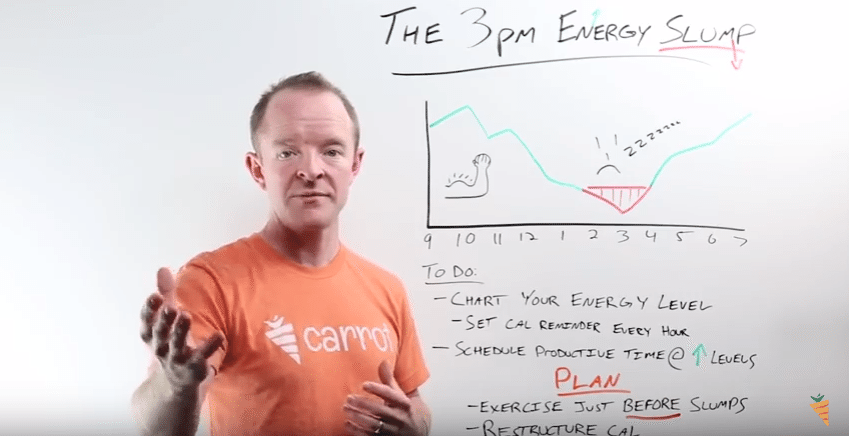
    We’re going to walk you through how you get out of the 3:00 PM energy slump. First of all, I’ve got this little chart here, and this chart is important because after I walk you guys through this process, I want you guys to create your own chart. I’m going to show you guys how and why that’s so important because my chart is not your chart. You guys might have a ton of energy at 3:00 PM, but your energy might slump at a different time during the day. This chart is basically the chart of mine.

    3pm-energy-slump
    Are you dozing off while reading this post? You’re in an energy slump. Beat it by following these simple tips to restructure your day and create the right mindset.

    I’m going to walk you through the process. I charted my energy level at every hour during the day for several days to find out when my energy was low and when it was high. That way, you can structure your life better and also tackle those low energy times and infuse more energy in them.

    I start at a pretty high energy level, but not when I first get up. When I first get up at 6:30 in the morning or when one of my kids is upstairs yelling to try to come downstairs, I’m not too high energy there. But what I do is I go through some steps to get high energy by 8:30 or 9:00 in the morning, oftentimes earlier.

    I get to work at about 8:15 in the morning, get really high creativity at that time, and I peak right there, and then my energy starts to steadily go down throughout the day, all the way up until 3:00 PM. For me, it’s oftentimes because I’m at my desk sitting, standing, sitting, standing with my stand up desk during this time.

    I’ve kind of gotten the roll of the day. The excitement of starting the day off has waned a little bit. I’ve kind of gotten my to-do-list, and then I ate lunch, got a belly full of food that might not be good energy food, and then you start to hit that lull. During that lull is when I’ve learned to try to shock your system back into place so you can get through that as quick as you can, so you can go back into a high energy state.

    For me, same time, it’s about 4:00 or 5:00 PM that I get a little bit higher energy. It’s kind of funny. Around 8:30, 9:00 PM, I’m pretty darn good, and then about 10:00 PM, I’m done.

    First… Take Note Of Your Energy Levels

    Okay, so what does your chart look like? I want you guys to chart your energy the next three days, and that’s it. It’s going to be really, really easy. Chart your energy the next three days. I want you to set a calendar reminder. Do it before you finish the video. Hit pause in this video in about ten seconds, after I tell you what to do.

    Set a reminder for every hour during your workday to gauge your energy level for the next three days. We’re talking nine to five, eight to whatever, whatever time is your work day.

    Set a calendar reminder that pops up and says, “What is your energy level?” Jot it down on a spreadsheet, a piece of paper, whatever. You can gauge your energy level in any way you want. You can do one to ten, you can do high, low, medium, however, you want to gauge it, gauge your energy level. Write it down.

    After those three days, you’re going to make your own chart. It’s going to show you when your energy is high and when it’s low.

    The high energy parts, figure out why it’s high, and write that down, and do more of that. Fit more of that in your schedule. The low energy times, oftentimes we don’t know why we have low energy at that time, and this is what we need to do to tackle that.

    The Plan

    We need to, first of all, schedule your productive time. It could be the time that you’re creative. It could be the time that you’re just doing the best work, the stuff that really makes a difference for you, the stuff you’re great at. Schedule that during your high energy level times.

    For me, right now doing this video, it’s before lunch. I haven’t eaten lunch yet. I know I’ve got good energy at this time. That’s why we’re doing our videos right now. If I were to schedule these videos at 2:00 or 3:00, even after I go through some of these steps to get my energy level up, it’s still going to be a little bit lower than normal, so scheduling your productive time during high energy times.

    Exercise Right Before Slumps

    All right, now here’s the plan for you. What you want to do is exercise just before the energy slump. It doesn’t mean you’ve got to go pump iron. It doesn’t mean you have to go run ten miles. Get outside, walk outside out of your house, walk outside of your office, and walk around the block. Walk a mile.

    That could be a really good, simple goal, just to walk a mile. It might take you fifteen, twenty minutes to walk a mile, maybe quicker. Do whatever works for you for exercise. It could be literally doing 15 jumping jacks in your office and just getting going. Set that in your calendar to do a quick exercise, ten minutes or so, just before the slump happens.

    Next, what you’re going to do is restructure your calendar. So put exercise on your calendar right before your slumps usually happen, a quick, simple exercise, ten, fifteen minutes max, just to get that going. You could go longer if you want to.  I’ve even seen some people do a quick five-minute exercise and it gets their energy level going back again.

    Everyone’s got five minutes, and that one five minute exercise is going to give you an extra two or three hours of productive and happy time during the day, which is a great investment.

    Change Your Eating And Drinking Pattern

    Now, you’re going to figure out your eating and drinking. It’s kind of funny. We just ordered lunch. Nate, the cameraman, just got a bacon cheeseburger, so I’m going to put him on the spot. I know for me, if I had a bacon cheeseburger with fries, I’m going to be in the sleepy zone in about two hours.

    Usually, it’s about 45 minutes after I eat something like that. For me, it’s high carbs. It just puts me in the gutter, so instead I got a salad. I’m not better than Nate. I just know where my energy levels are and I don’t want to be there because I’ve got a lot to get done today. Make sure you change your eating and drinking patterns.

    Also, drink a bunch of water, which I’ve been really bad at lately. That’s something I myself have to challenge myself to get back on that train of drinking a lot of water at the start of the day, and drinking a bunch of water also before your energy slump happens.

    Gain Lost Time Back

    If you guys go out there and do those things in your life and in your day, which it takes discipline, it does, but if you like having that energy slump and if you like giving away two, three, four hours of your day each and every day and not having that productivity or that happiness, that same energy level, that’s cool. Keep doing it.

    If you want to gain that time back that you’re never going to get back, find some ways to figure out your energy cycle.

    Reignite Yourself

    Restructure your calendar so it fits the productive stuff around that energy cycle.Then find ways to reignite your body just before those slumps happen so those slumps become less and less. You want those slumps to go from being low, to leveling out. That’s what’s going to happen when you guys implement this.

    Go out there, get more energy in your life, more energy in your day, and go out there and crush it. Let us know how it works in the comments section of the YouTube video or the comments section on the blog post, and we’d love to hear your feedback. Thanks, guys and gals. Go visit our other whiteboard strategy sketches on our YouTube channel, or subscribe here to the blog. Thanks, guys and gals. Go out there and crush it.

  • EP 15: How To Build A $200,000/yr Passive Cash Flow Rental Portfolio w/ Daniil Kleyman

    EP 15: How To Build A $200,000/yr Passive Cash Flow Rental Portfolio w/ Daniil Kleyman

    2016-10-02-carrotcast_danill_main

    I just flat out didn’t want to have a job anymore. I didn’t want to be responsible to anyone else. I didn’t want to have a set schedule. I didn’t want to be trapped in an office or a cubicle. I didn’t want to ride the subway at 7 o’clock in the morning wearing a suit.” -Daniil Kleyman

    Is your business doomed because you didn’t choose the right wealth building strategy?

    Subscribe and rate us on iTunes

    While everyone is trying to make a quick buck flipping, my guest today has built a $200k/yr net passive cash flow income from a simple and methodical approach to buying real estate.

    In addition, he has helped change the face of Richmond, VA and is passionate about creating communities that people LOVE to live in. Hear his story and learn…

    Enjoy :-)


    Past CarrotCast episodes


    Listen to the Podcast

    Subscribe To The CarrotCast On iTunes

    In this CarrotCast conversation Trevor and Daniil tackle: 

    • Asking yourself extreme questions when deciding on a new path.
    • Passive cash flow investing strategy.
    • Making smart real estate decisions right now.
    • Using a worst case/best case scenario in tough times.
    • Simplifying your life to have a clearer mindset.

    Watch the Video Version

    How To Build A $200,000/yr Passive Cash Flow Rental Portfolio w/ Daniil Kleyman Real Estate Investor

    3:00 – Why staying organized and contracting out certain phases of his business are important.
    5:20 – Daniil’s driving force behind investing heavily in one market vs. diversifying a bunch of different areas.
    7:15 – How he ended up in Richmond, VA after working for some pretty big corporate players in New York City.
    9:35 – Getting his start; investing in rentals coming out of 2008 and 2009.
    10:50 – How long it took him to reach his passive income goal. And… how he got there.
    11:55 – His strategy behind new construction and buying land. Tip: You’ll need to have patient money.
    14:30 – Where the market is going over the 12-24 months.
    20:30 – How to look at deals right now. Don’t get caught up in the tax auction action. Make good decisions.
    23:55 – The importance of having a positive mindset: It’s easier to make decisions when you expand the possible scenarios.
    27:20 – Using “worst-case” scenarios for planning – think worst case-best case when making a decision.
    31:55 – Lessons learned from amazing friends and how to stay grounded and stay happy. Daniil never hesitates to spend money on experiences.
    39:50 – His long-term strategy and how important setting goals is.
    42:05 – Having a passion for building communities. That is what hits Daniil at his core.

    You can find out more about Daniil at rehabvaluator.com

    [podcast-subscribe]

  • EP 14: From 0 to 3,347 Multi-Family Units: “How I Did It” w/ Carlos Vaz

    EP 14: From 0 to 3,347 Multi-Family Units: “How I Did It” w/ Carlos Vaz

    2016-10-01-carrotcast_carlos_vaz_main

    “We have 1, 3, and 10-year plans… I can tell you specifics on how the company is going to look 10 years from now. I can tell you the size of the portfolio, the number of employees, what we’re going to be doing, charities that we’ll be working with. I can tell you details.” Carlos Vaz

    The power of big ideas: When you really want to change something try thinking about the big things you want to change.

    More often than not you’ll find it easier, faster and most importantly, that it can be done. Do this often enough and you’ll accomplish your dreams.

    Subscribe and rate us on iTunes

    Carlos Vaz had a goal to purchase 2000 multi-family units in 2 years.

    The catch; he had no history making such deals and he was in a foreign market. Literally. He landed in Dallas Texas via Brazil.

    And, he nailed it.

    This is big-time thinking and big-time investing. Carlos dives into what type of mindset it takes to build a long term real estate investing plan and how to stay focused while driving towards that goal.

    Learn more about Carlos and Conti Real Estate Investments.

    Listen to the Podcast


    Subscribe To The CarrotCast On iTunes

    Diving in with Carlos Vaz…

    • Building your personal and business fountain and finding out what is important to you.
    • Learn how to discover and ID your market.
    • How to build relationships with brokers and banks.
    • How to look at and analyze properties. So you don’t lose.

    Along with some amazing mindset shifts!

    Enjoy :-)

    Watch the Video Version

    From 0 to 3,347 Multi-Family Units: “How I Did It” w/ Carlos Vaz

    Start – Creating a long term real estate investing plan.
    5:45 – How to think BIG.
    8:30 – Carlos’ journey from Brazil to Boston and eventually landing in Dallas, Texas.
    13:50 – What type of key factors did he look at when moving to the Dallas market.
    21:30 – Economies of scale. Scaling the number of units per multi-family from 150 units to 500 units.
    22:55 – How to fund really big deals.
    25:30 – How to work with brokers.
    26:20 – Should you use a management company or should you partner? How to find a good management company and what to look at when partnering.
    28:25 – What does a management company typically charge?
    33:30 – Stabilizing your first deal and how to get your first loan.
    35:25 – Non-recourse loans vs. recourse loans.
    37:30 – Who is the decision maker when working with a bank? And the drawback to financing with a bank.
    39:15 – Financing tips and what’s involved in due diligence.
    43:30 – Strategy behind what types of properties to look for. Hint: It’s all about the location. Also, looking at A, B, and C properties.
    48:55 – Create a portfolio mixture.
    50:00 – What resources are great to find properties.
    54:45 – Listen to what the market is telling you about properties.
    56:15 – How to build an awesome team.
    56:50 – Expanding past multi-family units.
    58:15 – The importance of having good core values within a company.
    1:01:20 – Why giving back to your community and the journey of giving back is so important.

    [podcast-subscribe]

  • 4 Step Marketing Budget Formula: Find The Magic Number You NEED To Invest To Close A Deal

    4 Step Marketing Budget Formula: Find The Magic Number You NEED To Invest To Close A Deal

    What if you could know that for every $1500 invested in online ads, you’re pulling $10,000 back? But, a lot of investors don’t take the time to calculate and understand what it takes to get a positive ROI. So, they quit too soon. Let’s fix that.

    Before we dive in, as you listen to this Strategy Sketch, you’ll need to use The Carrot ROI Calculator tool to help pencil in your own marketing budget.

    I’ve got a quick story for you, but before I start if this is your very first strategy sketch with Carrot we have a lot of other ones on our YouTube channel. Check them out after you watch this one.

    4 Paid Marketing ROI Steps Only High Real Estate Achievers Understand

    The story is of 2 different real estate investors…

    One real estate investor’s had an amazing return on their marketing.

    The other one struggled and lost all their money and ended up giving up.

    I want to make sure that you identify where in this story you fit. Which one of these are you resonating with? Which one of these are you living right now?

    The First Investor…

    The first investor had a marketing budget and he knew his numbers really well. I’m going to be walking through exactly what the first investor did to make sure he got a great ROI on his marketing.

    The Second Investor…

    The second real estate investor also had a budget. He dove in, he started spending money, he started investing money, but he did not do these 4 steps I’m going to walk you through.

    They both had the same amount of money to start, they both had the same amount of experience. One of them lost his butt on all of his marketing, the other ended up making tens of thousands of dollars.

    Now, this is not a false story. I was on one of our Coaching Calls recently here at Carrot and these 2 investors were on the exact same call. One of them ended up blowing $1500 on pay-per-click marketing. The other one ended up making almost $9,000 in the first deal because he followed these 4 steps.

    If you want to know the difference between really active and really profitable investors, these 4 things are going to be that.

    Let’s go ahead and dive in.
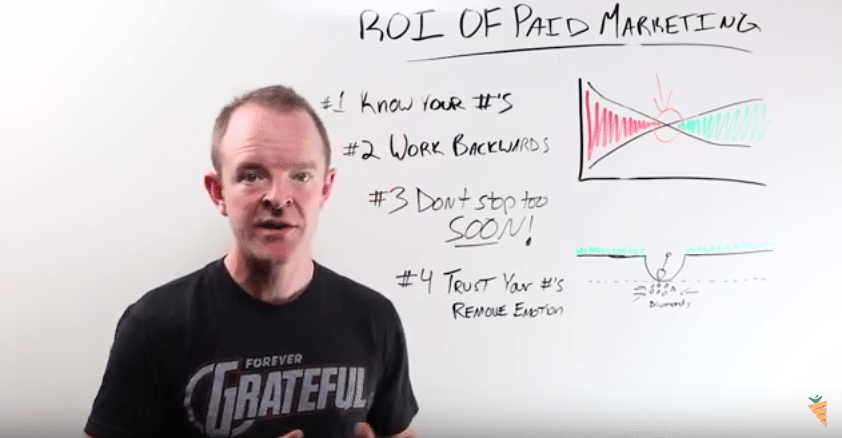
    ROI of Paid Marketing

    Step 1: Your “APD” – What Is Your Average Profit Per Deal?

    The first thing, how you get a great return on investment from your paid marketing? That’s what we’re talking about here is your paid marketing. A lot of this will translate over into the stuff where you’re just working kind of sweat equity for your marketing.

    Could be you doing your own SEO, could be you out there doing your own door knocking or whatever the heck it is, but we’re talking about marketing that you actually take your money and invest it into the marketing. It could be direct mail, pay-per-click, SEO, you name it.

    The first thing here is you’ve got to know your numbers, and I think a lot of people think that they know their numbers. They think, “I make about x amount per deal, I’ve got this much in my budget, and I’m just going to roll with that and we’ll see what happens.”

    You probably don’t know your numbers as well as you should but I’m going to walk you through in this video how you should know your numbers in a quick 30-second work your way backward formula.

    The numbers that you really need to know about your marketing: You need to know how much money you’re going to be making on each sale.

    If you’re a real estate agent, you need to know what your average profit per listing is. If you’re a real estate investor, you need to know what your average profit per deal is.

    If you’re not investing yet, go out there and investigate the market, talk to other investors in your market, and find out what their average profit per deal is. Write that down right now.

    That’s going to be a key number for you.

    Step 2: Your “LPD” and Website Conversion Rate – How Many Leads Before You Close A Deal On Average?

    The next thing that you’re going to need to know is what your conversion rate is. You’re going to need to know basically how many leads it takes to turn into a deal for you. You’re going to need to know all those types of things. We’re going to walk you through them here in a second.

    If you don’t know how many leads it takes for you to turn it into a deal, it’s going to be really hard to know your numbers and know how much you need to invest in your market.

    We’re going to work backward on some numbers and we’re going to help you identify your exact marketing budget so you know exactly what you need to invest with no guessing, take all the emotion out of it so you can just really focus on doing what you need to do. Invest in your marketing very intentionally and not stopping before you need to.

    Step 3: Don’t Stop Too Soon

    Third is exactly what I’ve led into. Don’t stop too soon. This is one of the biggest mistakes we see, not just for real estate investors or agents, in business in general. Too many of us stop way before we actually should stop. We invest a little bit of money in this marketing type and it doesn’t pan out right away and we go, “Oh my gosh, that must not work.”

    We throw up our arms and then we start something else and then we do that for a little bit. Then that doesn’t work like we thought it was. We throw up our arms and we move to something else again, and if you’re in that pattern right now.

    If you’re in the pattern of going and investing a little bit, dabbling, pulling back because you didn’t get the results you wanted, then you shift focus and you do the same thing, you’re probably going to be in that pattern forever until you change your thought process.

    If you’re in that pattern you’re going to be looking back in a year or two years or three years or even a month and going, “Oh my gosh, I ended up investing a lot of money, I lost a lot of money, I didn’t grow the business that I wanted to, I don’t have the freedom that I wanted, that I thought that I would have in my business,” and you’re going to blame it on everything but your marketing mindset.

    Having the right marketing mindset can save you from that.

    Step 4: Trust Your Numbers

    The fourth thing is you got to trust your numbers. You cannot go off of emotion in marketing. Marketing is an emotionless entity. You get emotion completely out of marketing unless you’re making your marketing materials. That’s a whole different video, a whole different strategy sketch where and how you use emotion in your marketing materials to really connect with your prospects. You can use emotion there. We don’t want to use emotion in how you analyze whether your marketing’s working or not.

    I read this book called Acres of Diamonds and this book basically is a very similar tale to the guys back in the gold rush in California, where there were many stories of these gold miners who would go in and they’d invest a ton of money in buying the equipment and people and digging and digging, and they get a little bit of gold but they did not hit the thread of gold that they thought they were going to hit.

    There was this one particular story, I don’t remember the gentleman’s name, but basically this guy built this big gold mine and he dug and dug and one day ran out of money and said, “You know what? I’m just going to quit because this must not be the spot.”

    What ended up happening was he ended up moving away, another miner came in and said, “You know what, this looks like it has promise. Let me dig a little bit further.” Within weeks this guy hit this massive payload of gold, 2-3 feet below where the other miner stopped, and the moral to the story there is you need to follow your numbers, not the emotion.

    If that first miner knew that gold was in there, he needed to make sure he knew how much budget he had, make sure he knew exactly what the ROI could be on the other end, and not stop until he hit those metrics.

    It ended up costing him millions and millions of dollars.

    How To Map Out Your Numbers

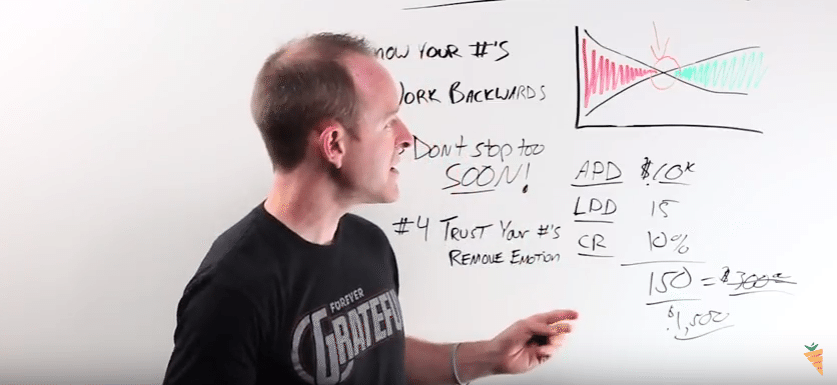
    What we’re going to do is we’re going to walk through a real example here, we’re going to map out your numbers, and we’re going to take it so your marketing turns from the red negative to the green positive. This point right here, this is what we call the inflection point in your marketing.

    Almost every time, you’re always going to have this ramp-up period. You’re going to have a period where it’s not giving you much of an ROI. With pay-per-click marketing, it’s going to take some time to get that optimized so your ROI, your return on investment, is where you want it to be.

    With search engine optimization, you’re going to be investing a lot of time and money if you’re hiring someone else to do it for 3, 4, 5, 6, 7, 8 months before you hit the inflection point and your rankings go up in Google and you start to get those leads and deals.

    We have to be long term focused. We cannot be short-term focused on our marketing, and we need to really be shooting for that inflection point, your break-even point, then from there, your profits start to really skyrocket.

    What we’re going to do is we’re going to work some numbers here. We’re going to work backward. And, we’re going to make sure you don’t stop too soon because now you’re going to know your numbers. That will help you so you trust your numbers and get emotion out of it.
    roi of paid marketing calculations

    Working The Numbers…

    Let’s start. If you’re a real estate investor let’s just work with wholesalers. What is your average profit per deal? Let’s assume that your average profit per deal is $10,000 in your market. So, we know that if you do a deal, you make $10,000. Now let’s work backward. How many leads does it usually take for you to close that one deal?

    The average for Carrot members, for online leads that are generated through our platform, is about 10-15 leads per deal right now.

    If you’re doing direct mail it’s about 20-40 leads per deal. If you’re doing pay-per-click it’s probably 15-30 leads per deal. We’re just going to run with 15 leads per deal for this example.

    Working backward, we know that we need to get 15 leads so we can get $10,000.

    If you’re doing pay-per-click marketing and you already have a campaign going and optimized, how much is it costing you to get a visitor to your website and how is your website converting?

    If you’re in a really hot market like a south Florida or LA or Portland, Oregon, websites, in general, are going to be converting lower than websites in a moderate market. If you’re in Birmingham or Louisville or something like that, your website for motivated sellers is going to convert higher than a hot market.

    So, don’t look at your friend in Kansas if you’re in LA and go, “Oh my gosh, my buddy’s getting a 10% conversion rate on his seller site, I’m only getting 3. What’s going on?” It’s probably your market, not your website if your website is set up the way that we teach.

    Now let’s work with a conversion rate. We’re going to do a 10% conversion rate. It takes 15 leads to close a deal, and then you’ve got your $10,000 profit. To get 15 leads, we’re going to need to get 150 visitors to our website. Your only goal now is how do I get 150 qualified people to my website? 150 people equal $10,000 to me.

    Let’s say you’re doing Google pay-per-click or something like that and you’re getting 150 visitors, costing you $2 a click. On average that’s going to be $300. Once again in this hypothetical situation, you need to having a marketing budget of at minimum $300. If you’re in a market where it’s going to be a lot more than $2 a click, say it’s $10-15 a click like a lot of markets are, you need to start adding those numbers up.

    Let’s say it’s $10 a click. Now that’s a $1,500 budget. $1,500 in order to get 15 leads, in order to get your $10,000 profit. Now the numbers are really starting to make sense, so those of you who are giving up after you put in $500 in your pay-per-click marketing, you need to be stretching all the way to your max budget. Give yourself a chance to let your numbers work for you.

    I think everyone watching this video will easily trade $1,500 for $10,000. If you won’t … please examine yourself because you need to be working the numbers like this.

    You cannot be going, “Okay, I want to invest $300 to get $20,000.” You need to be really thinking about those numbers in a big way because if you’re not, your competition is. If you’re in a market where you’re only willing to invest $400 to get a $10,000 deal but your competition is willing to invest $3,000, you’re going to get crushed every time in pay-per-click, every time in Craigslist, every time in SEO, every time in direct mail.

    You’re always going to get crushed because your competition knows their numbers. They’re going to take it up to their max budget, and they still know if they’re going to be able to profit.

    That is how you scale up your marketing. Know your numbers, remove emotion from it.

    1. Find out your average profit per deal first.

    2. Find out how many leads it takes you to close a deal,

    3. figure out your conversion rate on your website- which we can help you. If you’re an InvestorCarrot member we’ll help you with that. Just let us know and we’ll spin up a split test on your site to find out your conversion rate.

    4. Figure out how much it’s going to cost you to get those visitors to your site. Whether it’s through SEO or direct mail or pay-per-click. Figure out what that’s going to cost you to get your 150 visitors to the site using these numbers.

    Ramp Up Your Paid Marketing ROI

    Get out a piece of paper, figure out those numbers for yourself, get those calculations going, and get your return on investment ramped up for your business. Remove emotion from your marketing, go with your numbers, and work backward down the line.

    Sooner than you know it, you’re going to turn from dabbling to crushing it. And, it’s just going to keep on skyrocketing and going up.

    Thank you guys and gals for watching this strategy sketch. Make sure to check out other strategy sketches on our YouTube channel. Go over there, we have lots of great strategy sketches where we answer questions that you guys send in each and every week. Thank you guys and gals, we’ll talk soon.

  • EP 13: Traveling The World While Investing + Interns Closing Deals w/ Justin Lee

    EP 13: Traveling The World While Investing + Interns Closing Deals w/ Justin Lee

    2016.09.04-CarrotCast_Justin_Lee_main

    “We talked with enough interns to know that their number one complaint is “I went on this internship and I sat around and there was nothing for me to do.” Which is insane!” Justin Lee

    How would you like to receive a check for $21,000 while on a 9-week European vacation? Visualize that for a sec… Pretty cool, huh?

    Subscribe and rate us on iTunes

    We all have passions, right?  But… do you know how to achieve those passions?

    Our CarrotCast guest, Justin Lee, lives for traveling. But not just any travel. How about vacations to exotic locations that last 2 months!

    Listen to this podcast to learn how he has been able to create the freedom and income to work while living the experiences he wants to live. This freedom has been powered by over 50 interns that have come and gone on his real estate investing team.

    We walk you through his ingenious hiring and training plan for his interns and how they help scale his business. It’s not just a one-way street. He has also helped some of his interns create their own very successful businesses.

    Enjoy :-)


    SEE ALSO


    Listen to the Podcast

    Subscribe To The CarrotCast On iTunes

    Diving in with Justin Lee…

    • Long-term wealth strategies using real estate wholesaling.
    • How to build a team via interns. From hiring interns to providing them with life skills.
    • Delegating very specific roles to interns.
    • Fitting family and life around a busy schedule.

    Watch the Video Version

    Traveling The World While Investing + Interns Closing Deals

    3:40 – How Justin ended up in real estate investing where he’s been able to be successful while wholesaling in three competitive markets.
    6:30 – Long-term wealth strategies in real estate.
    8:15 – How to utilize seller financing.
    9:30 – Knowing that you can’t fake through your weaknesses.
    13:30 – Using a buy and hold strategy. Or, can you pick and choose deals?
    14:30 – The horizon principle – how much income is enough to stay afloat.
    15:40 – Hiring interns. How he builds a team via an amazing idea. Find out where he gets interns.
    18:00 – Success story: The best intern Justin ever hired, now has a successful online amazon store.
    21:30 – The types of roles that interns have within his real estate business.
    27:39 – The InvestorCarrot positive ripple effect.
    28:40 – How to attract and retain good interns.
    32:05 – Do you pay interns?
    34:55 – Quick tip if you’re getting ready to hire an intern.
    36:10 – How to fit family experiences into a busy schedule.
    42:40 – How to set real expectations when taking a break.
    48:10 – Entrepreneur’s need to take breaks to recharge their batteries.
    49:30 – How to grow as an entrepreneur.
    52:15 – Why Justin chooses to be an entrepreneur in the real estate world.

    You can get more information about Justin’s intern process at internprofits.com

    [podcast-subscribe]

  • Ep 12: Building A Business Of Freedom, Purpose & Profits w/ Trevor Mauch and Adrian Nez

    Ep 12: Building A Business Of Freedom, Purpose & Profits w/ Trevor Mauch and Adrian Nez

    2016.09.03-CarrotCast_Adrian_main

    “If you can’t function and be the same person in your personal life and in your business life, you’re just going to burn yourself out.” -Adrian Nez

    How do you get more out of your business? How can you shift your mindset so you can scale your business beyond yourself?

    Listen to this powerful CarrotCast to find out.

    Subscribe and rate us on iTunes

    In this CarrotCast, InvestorCarrot CEO, Trevor Mauch is joined by a real estate entrepreneur, one who is not only a member but also a Carrot employee.

    Adrian Nez is one is one of the first Carrot success stories. He’s an expert virtual wholesaler based in North Carolina while wholesaling in the Pittsburgh, Pennsylvania area.

    Real estate is a topic on this call, but even more intriguing, is the topic of having the right attitude in life.

    Trevor and Adrian have been through some of life’s toughest struggles. They were able to breakout by having the right mindset.

    You’re practically guaranteed to walk away from this podcast with a better attitude and more passion.

    Enjoy :-)


    SEE ALSO


    Listen to the Podcast

    Subscribe To The CarrotCast On iTunes

    In this CarrotCast conversation, Trevor and Adrian dive into…

    • Building your personal and business fountain and finding out what is important to you.
    • How to build a set of core values.
    • The psychology of placing positive things around you.
    • Scale your business to build freedom, purpose, and profits.
    • Building a team based upon having the right mindset.

    Watch the Video Version

    2:40 – Character versus accomplishment.
    7:10 – Building a foundation using what is important to you.
    11:00 – How to create an effective set of core values.
    17:35 – How Adrian became one of Carrot’s first customers.
    20:40 – Importance of functioning and being the same person, whether at your job or at home.
    22:30 – Empower your team to have fun and make a bigger impact.
    28:40 – Change the way something looks by how you present it. 
    32:20 – Setting the tone of your day early has a positive ripple effect.
    39:00 – Find your main motivator but don’t always chase numbers. If you do that, you’ll always be disappointed. Keep yourself in check by leading back to your core values.
    45:28 – How a mindset change has molded Adrian’s take on the future.
    50:25 – How to scale your business and tips for hiring a VA or assistant.
    55:00 – Top questions to ask before hiring an assistant.
    1:03:30 – Emulate companies and people that you strive to be like.
    1:13:15 – The type of mindset you need while going through the journey of being a solopreneur to hiring VA’s.
    1:16:25 – How to nail your core values and build the business that you want to create so you can motivate and help others.

    Don’t always chase numbers. If you do, you’ll always be disappointed.

    [podcast-subscribe]