Author: Trevor Mauch

  • Why The “2-Step Opt-In Process” Increases Conversions and Lead Quality By Up To 46% On Real Estate Investor Websites

    Why The “2-Step Opt-In Process” Increases Conversions and Lead Quality By Up To 46% On Real Estate Investor Websites

    Welcome to another edition of the Carrot Test Kitchen… where we break down our recipes and show you how to create insanely great lead generation sites for your real estate business.

    Our sites get insanely high conversion rates… you just have to customize them to your business and your local market, then send traffic to them! (Don’t worry, we’ll show you how – it’s easier than you think. :)
    (Of course, this stuff is baked right into our sites, and our prices are so low that it’s impossible to do it cheaper yourself… if you’re not already a member, head over and check out our demo right now).

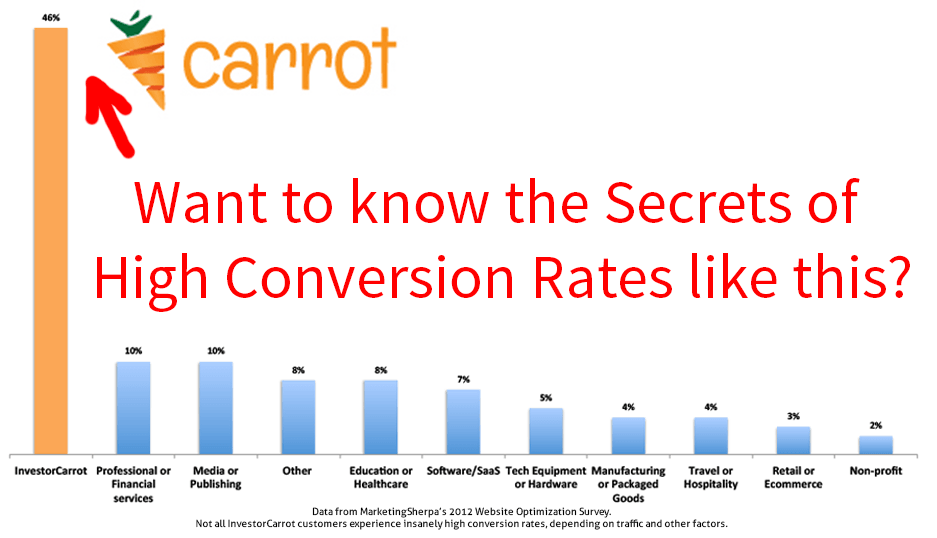
    Today we’re gonna show ya the exact trick that improved conversions by 46% right when we started implementing it years ago.

    It’s so simple that once you learn it, you get it… in fact, I bet you’ve seen versions of it used before. While we didn’t invent it, we’re perfecting it for real estate investors.

    It’s called the 2 Step Opt-In Process, and I’ll tell you how it works and what you need to know to make money from it.

    The first step of the opt-in process happens on the Lead Page – there are many lead pages built into every InvestorCarrot website, and you can create unlimited additional Lead Pages. It’s super cool.

    Step 1: Research Shows A Form With 4 Or Fewer Opt-In Fields Increases Opt-Ins On The Front End

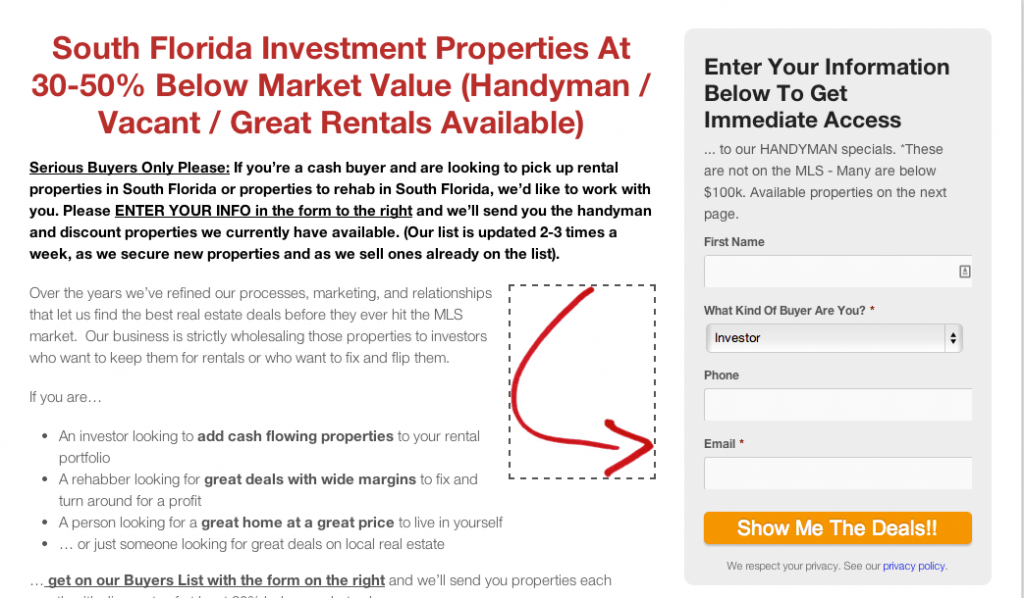
    Below is an example of a lead page on a Cash Buyer site on the InvestorCarrot system. It’s a great landing page for advertisements on Craiglist, Backpage, Zillow, Google, Adroll or many other sites and converts consistently high across our member’s sites too. :
    Heatmap____Visual_Website_Optimizer

    COPYRIGHT NOTICE: All of the content on our websites are 100% Copyright protected and owned by our company. Only active paying InvestorCarrot members can use the content on our websites. If we find people copying our content off of our customer’s websites or from our images on this page, we will pursue violators for copyright infringement. 

    As you can see, there are only a few quick questions to answer – name, email, phone and type of investor.

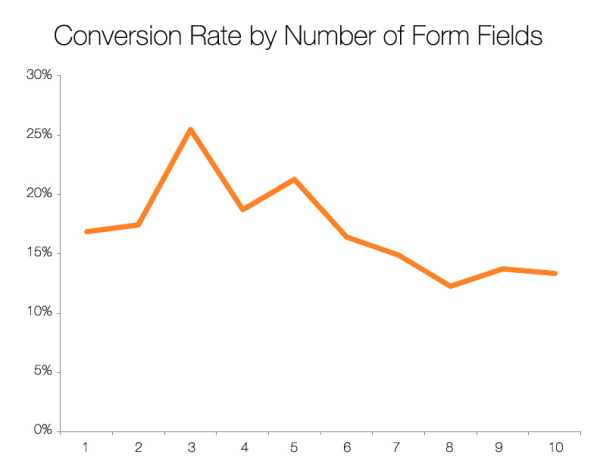
    Lots of testing has shown that 3-4 form fields are ideal for conversions – any more or less actually drops the rate of performance. This graph from HubSpot’s research on over 70,000 forms shows why 3 is the magic number for conversions:
    fields-resized-600
    Want to Increase Your Leads? Make your first opt in form have 4 or fewer fields. – Source for Graph:  HubSpot

    We’ve tested the number of things our forms ask for on the first opt in box for both buyers and sellers… and once you start to get past 3-4 on your first form… your conversion rates go way down.

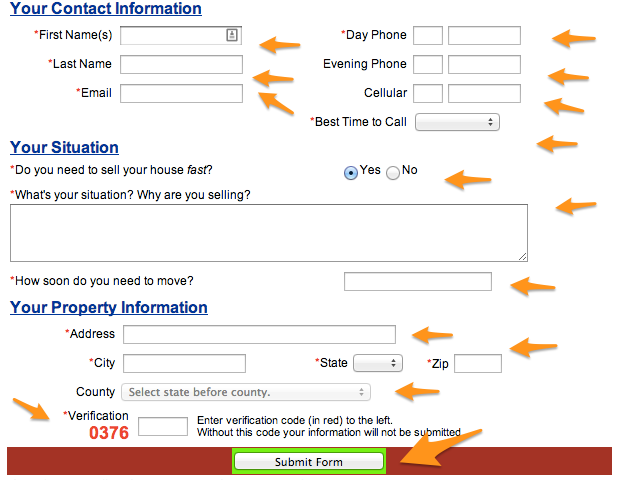
    You’ll see lots of real estate investor websites that are killing their conversions by asking for way too much information on the first chance.

    Like this one…
    real estate investor website conversions
    Too Many Fields Kills Conversion: This particular form we found on a random real estate investor motivated seller website has 13 fields. How many does yours have?

    Can you imagine being a motivated seller who really needs to sell… but just isn’t ready to give up all of your info quite yet on this first form… yet almost every field on that form is required for you to get to the next step?

    However, when a motivated seller does submit this form… you know that they’re VERY QUALIFIED.

    Long forms are terrible for conversion… but increase the quality of your leads.

    So we melded the two into…

    Step 2: The Best Of Both Worlds – High Conversions AND Qualified Leads

    A short-form upfront to increase lead conversion… and a long-form on the second step to increase your lead quality.

    To get the highest conversion and the most qualified leads (the ultimate goal), the key in the 2-step opt-in process is a short and sweet “Step 1” form… that leads to a longer more qualifying “Step 2” form.

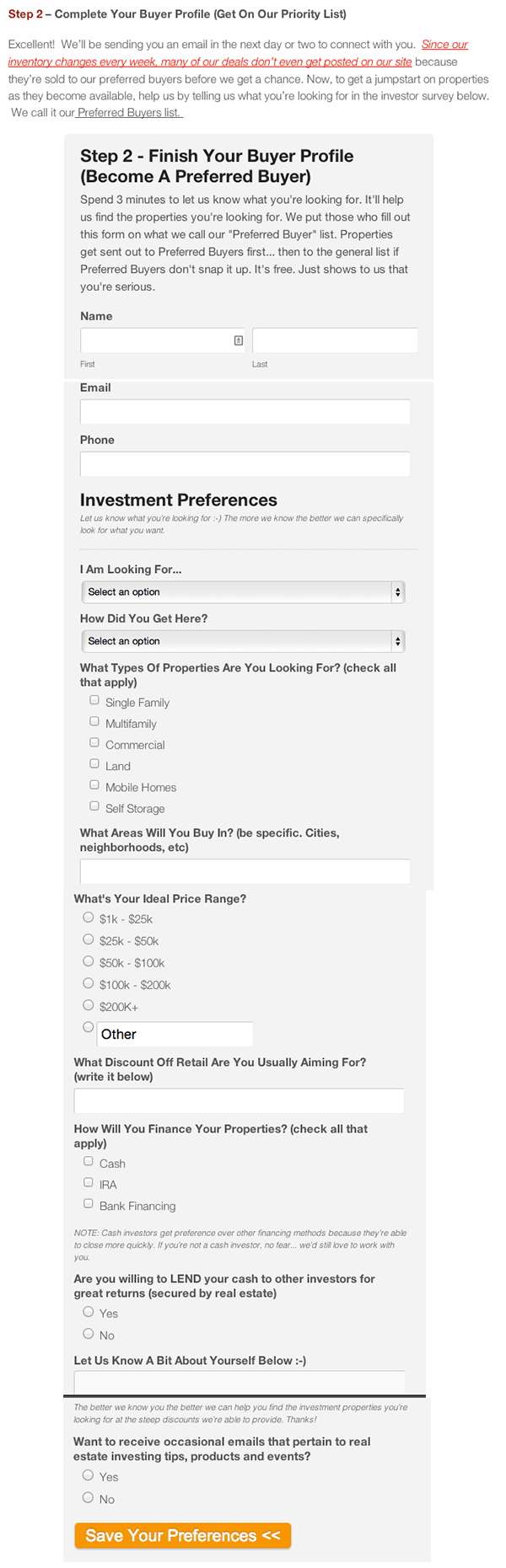
    Once the buyer (or seller) completes the first form… the shorter form, he or she will see a more detailed Buyer Profile to fill out before seeing the properties. This Buyer Profile Form further qualifies the buyers. The same goes on our motivated seller websites… we have a short form upfront that gets the lead… then a longer form on the back that qualifies the lead further:
    second-page
    Hidden Elements: There are many “under the radar” strategies being used on this form that you probably don’t even notice that further qualify the lead and increase conversions. For instance, notice that we’ve strategically made some fields “required” and some not required. Why? We reveal this kind of deep strategy to our InvestorCarrot members on our weekly LIVE coaching calls with our CEO Trevor. Not a member? Join :-)

    COPYRIGHT NOTE: Again, please be creative and write your own content. The content above is owned and written by InvestorCarrot… and only available for use by our active paying members. We actively monitor the internet to find people infringing on our copyright and pursue action. We have to do this to protect our active members and the investment they and we have made. If you’d like to leverage our system, our content, see our pricing and plans and come aboard, we’d love to have ya! 

    Do People Actually Fill Out A Form This Long You Ask?

    We get pushback from many InvestorCarrot members who want to change this step 2 form because they think it asks for too much info and the buyers and sellers won’t fill it out.

    Our answer to that is this… we’ve tested it… and it works.

    Here’s real-life data to prove the way we’ve set up OUR Step 2 forms (every word and every line on our forms and the other words on the page that the forms sit on… which isn’t shown above… are crafted and tested to increase conversions… and your leads).

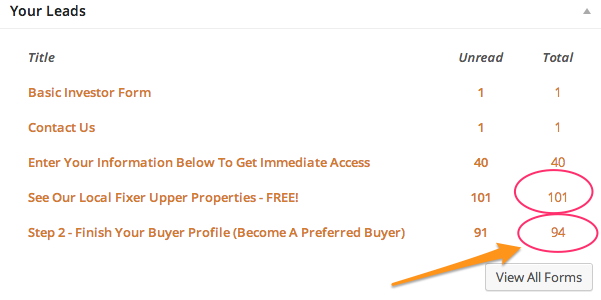
    93% Of Cash Buyers Filled Out The “Step 2” Form
    Dashboard_‹_Hot_On_Wholesale_—_WordPress-4
    93% of Buyers Filled Out The Step 2 Form: In this screenshot on an Carrot members cash buyer website 93% of every cash buyer who filled out the first form went on to also fill out the 2nd longer form. It’s no accident… the way we craft our 2 step opt-in process plain works.

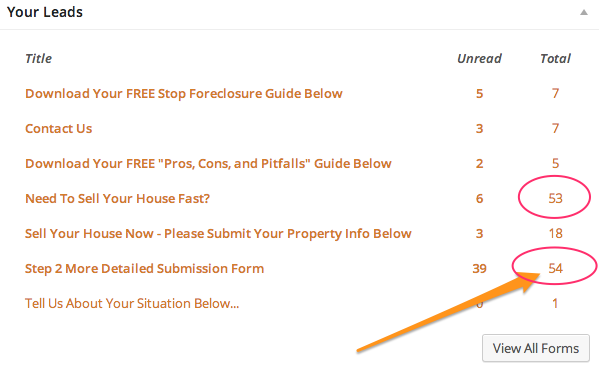
    99% Of Motivated Sellers Filled Out The “Step 2” Form
    Dashboard_‹_Real_People_Real_Property_—_WordPress-3
    99% Of Motivated Sellers Filled It Out: It works even better with motivated sellers.

    Again, it’s not just the fact of having 2 steps that’ll optimize your conversions and quality of your leads… it’s what you ask for on your forms and how you frame that “Step 2” form on your page that makes it work.

    If you’re an InvestorCarrot member, rest assured… this is already built right into all of your websites (your seller websites, cash buyer, rent to own, apartment rental, main company, etc.).

    Years ago, we found that the 2-Step Opt-In Process improved conversions by 46%… with dramatically improved lead quality.

    We’ve been using 2-Step Opt-Ins on all of our sites ever since.

    If you’re trying to build a real estate investing website from scratch to capture seller and buyer leads for your real estate investment business, you’re probably missing a few other key aspects of the formula that allows us to get insanely high lead capture rates for our members.

    Want to just leverage our research and our platform and save time and money?

    Join InvestorCarrot below… all of our websites come pre-built with the “2 Step Opt-In Process”.

    Want to see what else Carrot’s sites can do? Watch the demo now!

    Are you a paying Carrot Member wanting to improve your marketing results?

    Join our Live Coaching Call <– click<<<<<<

    Each week we answer specific questions from our members to help them solve their toughest marketing challenges.

    Space is limited, so sign up now! It’s free for Carrot members.
    If you’re not already a Carrot Member, joining is easy <—– Click that now to get started!

  • Carrot Case Study: Why A Website Developer Decided To Use Carrot To Grow His Real Estate Business

    Carrot Case Study: Why A Website Developer Decided To Use Carrot To Grow His Real Estate Business

    When we first got started here at InvestorCarrot we were honestly focusing mainly on investors who wanted a quick, easy way to get the best performing real estate website online fast at a great price.

    But over the last six months (when this story was filmed), we’ve realized that Carrot is attracting a type of customer we hadn’t expected quite as much…

    … people who are advanced real estate investors can build their websites themselves but find it more cost-effective and effective to their bottom line to use our system rather than build their website.

    If you’re in that boat… the “I’ll just create my own WordPress website and go it on my own” mindset… you’ll want to watch this video case study.

    David Brown NY Real Estate Business

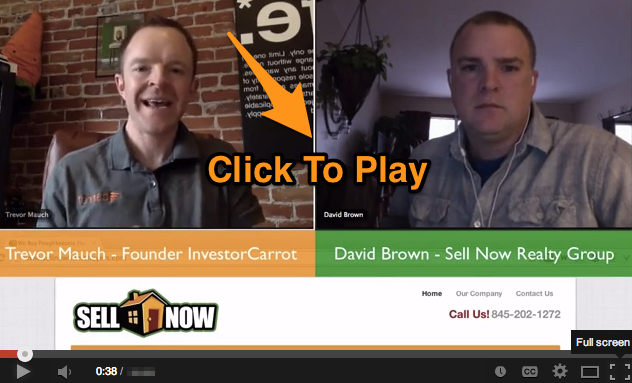
    This first Carrot Client Case Study / Review is from David Brown of Sell Now Home Buyers in New York.


    Investor Carrot Customer Story - How David Brown Uses Carrot for Content Marketing

    In this video case study, you’ll… 

    • Hear David’s “startup story”… how he got started, what struggles he went through, how he overcame them and how he’s grown his real estate business.
    • Learn why David, even though he owns a company that builds custom real estate investor websites (they build GREAT sites too), chose to join InvestorCarrot instead of building himself a website (HINT: He explains why Carrot is in the long run actually lower cost, more effective, and less hassle… all giving him MORE TIME to spend doing what he enjoys)
    • How David is driving traffic to his websites currently
    • Why he loves video marketing in conjunction with InvestorCarrot to generate great SEO rankings and leads
    • … and more!

    It’s a great call that’ll inspire you and walk you through David’s real estate business journey… and if you can build your own websites (or if you have a “nephew who said he’ll build me one for $200″… this interview will show you why that decision is costing you MORE money vs. just joining Carrot).

    Leave a comment below if you have questions for David, or just throw David some props!

    Interested in learning more about InvestorCarrot?

    Take a Carrot Demo Today <<

    (or see our pricing and plans to join today!)

    *Note: David is focused and determined and worked her butt off at the beginning to get the results he’s earned.  David did purchase the 3 Lead Per Day Training program upgrade (only $99) and applied the training diligently for several months to get him high rankings in Google and the leads that have come with those rankings. Your results will vary. Our most successful clients are the ones who have a positive mindset and have a plan for generating traffic to their website and implement that plan (the 3 Lead Per Day Training lays out a plan, so if you don’t have plan, upgrading to that training may be a good option for you after you sign up).  Those who just set up websites and don’t do the work will get results equal to the effort and focus put in.  

  • Client Case Study: From ZERO Leads To 1 Seller Lead Per Day – Brittany Bolling

    Client Case Study: From ZERO Leads To 1 Seller Lead Per Day – Brittany Bolling

    I’ll tell you what… there are two things that we as humans absolutely LOVE… they’re ingrained into us from birth I think.

    That’s hearing stories…

    … and hearing about how people became successful.

    So, here at Carrot one of our ongoing efforts in inspiring real estate entrepreneurs and providing you with the best tools to help you generate more inbound online leads to your business is to get our customers on to tell their story.

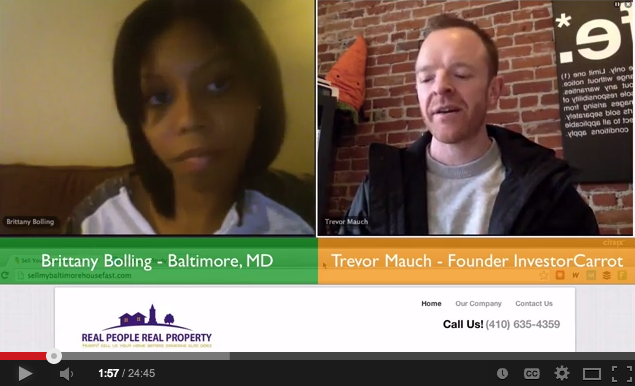
    This first Carrot Client Case Study / Review is from Brittany Bolling out of Baltimore, MD.

    Investor Carrot Candid Customer Review - Brittany Bolling

    In this video case study, you’ll… 

    • Hear Brittany’s “startup story”… how she got started, what struggles she went through, and how she overcame them
    • Learn how Brittany got her first online motivated seller leads using the InvestorCarrot system by following our proven process (and leveraging our system correctly)
    • How long it took Brittany to get ranked #1 or #2 for all of her main keyword terms in the Baltimore, MD market
    • How she closed her FIRST deal, which netted her $7,500 through an online lead
    • The BIGGEST OBSTACLE that she had to overcome that was blocking her from actually closing deals with the leads she was getting
    • Her mindset shifts and what she did on a daily basis to get up to 1 seller lead per day in a competitive market
    • … why she’s 100% focused on online “inbound” lead generation through Carrot (she’s closed 4 deals in the past 4 months 100% from online leads)
    • … and more!

    It’s a great call that’ll inspire you and walk you through Brittany’s journey from startup to today.

    Leave a comment below if you have questions for Brittany or just to throw Brittany some props!

    Interested in learning more about InvestorCarrot?

    Take An InvestorCarrot Demo Today <<

    *Note: Brittany was focused, determined, and worked her butt off at the beginning to get the results she’s earned.  Brittany did purchase the 3 Lead Per Day Training program upgrade (only $99) and applied the training diligently for several months to get her high rankings in Google and the leads that have come with those rankings. Your results will vary. Our most successful clients are the ones who have a positive mindset and have a plan for generating traffic to their website and implement that plan (the 3 Lead Per Day Training lays out a plan, so if you don’t have plan, upgrading to that training may be a good option for you after you sign up).  Those people who just set up websites and don’t do the work will get results that equate to the effort and focus put in.  

  • [Real Estate Heat Map Results] Where Are Sellers Clicking On Your Real Estate Website

    [Real Estate Heat Map Results] Where Are Sellers Clicking On Your Real Estate Website

    This article is the first in our Carrot Test Kitchen series – it’s a series of posts that help you to dissect the secret recipes we use to generate thousands of leads for real estate agents and investors across thousands of websites around the USA.
    heatmap-results-header
    Ever heard of “real estate heat maps”? We’ll show you how motivated sellers interact with your website and how to make your website more effective…

    Are you putting lots of effort into building a high-converting real estate website to pull in buyers, sellers or investors… but not getting the results you want?

    There are two main problems that we often see on real estate sites:

    1)   The site is getting no visitors, and

    2)   The site’s visitors aren’t submitting their information.

    The first problem is usually solved with SEO content when:

    1)   The site doesn’t have good content,

    2)   The content is not optimized to reach the search terms that people in the local market are actually using, or

    3)   The site’s competitors are ranking higher in a search.

    There are quite a lot of other tricks to boost traffic to your site, and we’ll be talking about that again real soon…. But today, I want to help you out with the second main problem we see:

    What are people doing on your real estate website?

    It’s critical that the design of your site is set up to actually convert visitors to leads.

    Although it’s utterly crucial, conversions are often overlooked when average people are putting together their websites. Too often they hire designers who are obsessed with aesthetics… rather than results.

    Those folks need to quit calling themselves marketing experts… because they’re artists. Most art doesn’t sell. It hangs there, looking pretty… but it’s not selling your business.

    Are you trying to create art, or are you trying to get real estate leads?

    Listen, I get in this argument with designers a lot… so please don’t send me a bunch of angry emails about how design matters… I know it matters. It’s just that it doesn’t matter if it’s pretty… it matters if it works. Like with my accountant – I don’t care if my accountant is pretty, I care about what happens if I get audited.

    When you’re setting up your real estate site, it’s not how it looks… it’s how it works.

    That’s the really cool thing about real estate heat maps – one of the many tools that we use at Carrot to test out our theories of web design… because we don’t even trust ourselves – we want to know that our system is built on proven data about what works before we commit your hard-earned cash – and more importantly before you shift the marketing of your business to our system. We know your business is super important to you… just like ours is to us.

    So what’s a real estate heat map anyway, and how can you use it to generate more leads online??? 

    Back to the point, thanks… in this context, a heat map is a generated picture of where visitors to the website move their mouse and where they click on the page.

    Below I’m gonna put a few examples of a heat map that we generated for a user’s site, and give you a few key points on what works so well on this design.

    Brittany sent us a quick email after watching one of our webinars, asking for help getting more leads… we were able to double her conversion rate with just a couple of simple changes that I’ll get to soon.

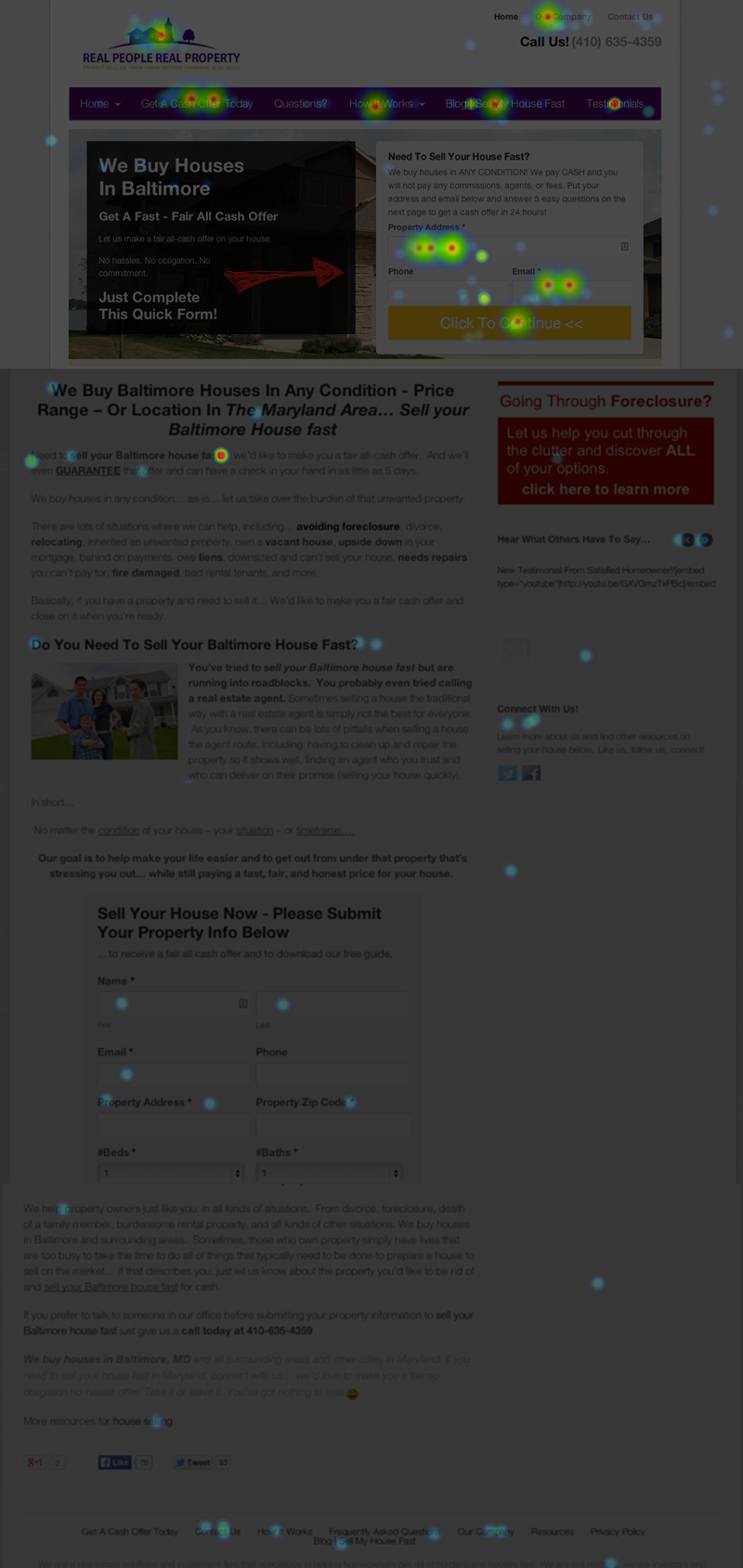
    Check out these heat maps (the site is greyed out, with little points of light showing where people have lingered with their mouse or clicked – the “hotter” the click spot, the more often it’s clicked).

    real estate investing website heat map

    What did you notice on that heatmap?

    See all of the bright spots? The Orange and Yellow spots are where a lot of people click… indicating things that the motivated sellers felt were really important.

    …94% of clicks happen on the top of the page…

    First off, 94% of clicks happen on the top of the page. The vast majority of web visitors to any given site don’t bother to scroll down – in fact, they make the decision to stay or go on to another site within 2.3 seconds.

    Side note: That statistic is valid across websites in general – on our investment sites, we tend to get about 8 seconds per page on average – 4 times more engagement than average, but still a lightning-fast choice to stay or go. You only have microseconds to reach your target audience – just another reason that your content and design matter so much.

    There are a few great lessons to learn right away from this click map…. 

    1)   People are clicking in many spots. The clicks aren’t just happening in one spot… visitors to this real estate website are clicking through to find information that answers their questions. The site is designed to appeal to a specific audience (sellers), so it’s validating to know that different visitors to the site are finding what they’re looking for on the site – and then submitting their information.

    2)   Titles matter a lot. Check out the title of the top menus – these titles are designed to appeal directly to people who need to sell. “We buy houses in Baltimore”, “Get A Cash Offer”, “Sell My House Fast” and a contact form right on the front page that asks people to put in their address, phone, and email first thing.

    3)   Customers want to know about the company before they submit their info. Check out how red the spot over the testimonials is – not only are people clicking a lot on that page, but they’re thumbing through the testimonial mini-display on the bottom right of the page. Testimonials are a huge way to create credibility for your business… more on that in a minute.

    Where is your credibility on your own real estate website?

    It’s a really common problem that hurts a ton of great real estate agents and investors… when people get to the site they need to have a compelling reason to give over their personal information. Think about it… real estate is the largest investment most people ever make in their lives. There’s no piece of real estate more intimate than someone’s home.

    And yet…

    So many real estate sites don’t build trust or credibility.

    In fact, there are 3 key factors that I wanna mention that are critical to successfully designing a site that converts – and I’ll tell you how we’ve used them to design the Carrot sites like this example that are generating great leads.

    Credibility, Content, and Contact

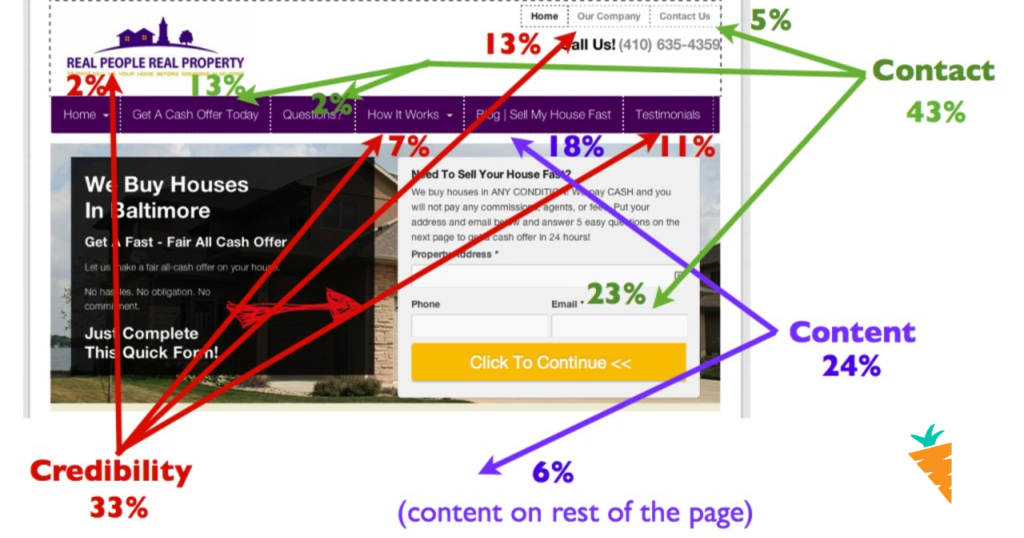
    Check out this graphic – I’ve broken down the links on the page into numbers, so you can see the percentage of page visitors that clicked on each link or form.

    Even more great lessons here… 

    As you can see, 33% of the clicks are for Credibility, 24% is on the Content (which is written to develop trust and credibility while reducing the fear and anxiety that most people who need to sell now are feeling), and 43% of the clicks on the home page are actually converting – they’re contacting members using the forms.

    Now, keep in mind that the percentages are recording just clicks on the home page – a lot of other conversions happen on the lead pages that we’ve optimized for the local market.  That means that people are most often giving their info over to get a free report or another valuable tool… 43% of the clicks on the home page isn’t always the main source of leads. It just depends on how the site is being promoted, and where the majority of traffic is directed.

    I really want to emphasize that the mix of those 3 factors is critical to a successful lead generation site.

    Content pulls people through search engine traffic, but it has to create Credibility once people arrive… or they just won’t Contact you.

    BONUS: 1 Minute Tweak That Doubled The Conversion Rate To Leads

    One more thing… I promised that I’d tell you the simple fix that we did on this page that doubled conversions… it’s so crazy simple that we were totally surprised that it worked so well.

    We increased the size of the bar that says “Click to Continue” on the opt-in form and changed the color to Orange.

    Yup, that’s it.

    When this Carrot member got in touch, her site was converting well… but she’d made the size of the Continue button pretty small and black… so we ran a split test – half of the visitors to the site saw the small button, and the other half saw the larger button (we also changed the color to yellow).

    In just one month of running the test, visitors to the large-button site submitted their info twice as much as those who saw the small button. Wow!

    Even after doing this stuff for years, it’s crazy to see what a big difference such a small change can make.

    That’s why we’re constantly testing different sites. We love to learn the nitty-gritty details that make all the difference… we don’t rely upon assumptions, and we certainly don’t make our websites to be pretty – although we do think they look nice. Most important – we design them to be effective.

    For marketing folks who love data, real estate heat maps are a fantastic tool.

    This Is All Built Into Your Carrot Websites Already!

    The beauty with everything we walked through in this post is that everything is already baked right into your Carrot websites. We’re constantly running tests with our members and making tweaks to improve how well our system works for you.

    We get paid up to $6,000/mo by large companies to do this same kind of work for them… but you get this as part of your Carrot membership for no extra cost. Why? Simply because we believe in results over anything else and are continually improving our system to help you get better results.

    Keep An Eye Out For More Articles Like This!

    We’ll be posting lots more info on the tips, tricks, and techniques we use to improve SEO, conversions, and get great results for Carrot customers… so if you’re not already getting our emails, make sure you sign up now! And if you want a website that truly generates leads for your business, go check out our different member plans to join Carrot and leverage our marketing knowledge and testing to generate more leads for your own real estate investing company. 

    Not An Carrot Member? Take A Tour Of Our System >>

  • 13 Thoughts On Being An Entrepreneur – From Carrot CEO Trevor

    13 Thoughts On Being An Entrepreneur – From Carrot CEO Trevor

    My (Trevor's) office at our Carrot headquarters in beautiful Roseburg, Oregon.

    [post was originally posted on Trevor’s personal blog, check out this and more over there. Oh, and by the way, my personal blog is also on our Carrot platform!]

    This past year I’ve been engulfed in entrepreneurship. Yes, I’ve been an entrepreneur since the day I graduated college… but this past year has felt more entrepreneurial for me than any other year in my life.

    I’ve learned a lot this past year. Here are 13 thoughts on being an entrepreneur

    What not to do (still learning). What to do (still learning massively). How to actually start a real company that can scale and be valuable some day (not just a little “income stream”). How to spot the “fake entrepreneurs” and like Mark Cuban says… the “wantrepreneurs” (they’re everywhere). How to build massive mission and purpose into a business like I’ve never known before.

    So, I’m sitting down in Chicago in my hotel before I fly back home and want to throw out 9 thoughts on being an entrepreneur. Not “what you should do” stuff… because what I should do has nothing to do with what YOU should do.

    Don’t copy me, it won’t work. One thing I’ve found is you have to find your own way (yes, mentors help you hopefully find that way faster, but you’ll still make your mistakes along the way… trust me… even ones you swore you’d never make.

    Here we go…

    1. Entrepreneurs Aren’t Made

    As Gary V. says… “it’s in your DNA”.  I used to have this idyllic dream that “there’s an entrepreneur in everyone”. I’ve found thats a load of (you know what).

    You may not be cut out to be an entrepreneur. A day job may be what you’re cut out for. And there’s nothing wrong with that. What EVERYONE is born for I believe is doing something they love… but most people stick themselves with jobs and day to day existences that they hate.

    If you’re not cut out to be an entrepreneur… get a job at a great place… do your job better than anyone… be passionate about it… and things will work out.

    2. It’s Always Harder Than You Think… Even When It “Feels” Easier

     You see the big stories on TV or in the news of the huge successes in business. Facebook… Instagram selling for a billion… on and on.  Those are stories that the media picks and chooses the “sexy” parts of the story… because that’s what people want to hear.

    Then the world goes out, has an idea, creates a “startup”, maybe raises some money, and realizes this “entrepreneur thing” is way harder than they thought when they actually have to make money to pay the bills. No one ever sees the behind the scenes of the success stories.

    The 19 hour workdays the first 6 months trying to get a killer product out before the market passes you by, the scraping by eating canned chili and grilled cheese 3 nights a week because your bills outweigh your income (ask me how I know that one), the marketing campaign that doesn’t go as you planned the first time, organizing your day (and life) when you have full freedom and flexibility (way harder than I thought).

    Take what you think it’ll take to start a company, times that by 10, and you’re closer to reality.

    3. Legacy Trumps Profits

     My first few years as an “entrepreneur” was about profits. That sucks. No fun. It’s a drain on your soul and a waste of your potential. Now legacy comes first over profits for me.

    I want what I create and the impact I make to last… to affect hundreds of thousands or even millions of people in a positive way… for people 50 years from now to look back and say… “Man, that guy made shit happen”.

    4. Competition is a Copout

    Buck up and work harder and smarter… that’ll trump competition 9 days out of 10.

    5. Entrepreneurs are Attracted to a Mission

    It’s built into us at our core. Give us a problem to solve… and we wanna solve it, make it make money, and improve the damn thing before know it.

    If you want to make a truly HUGE impact as an entrepreneur… attract other entrepreneurs to YOUR mission and have a community of entrepreneurs work their asses off to make that mission a reality. We’re doing it right now in my small town.

    If you’re in Oregon and are reading this… give us 5 years and see what Roseburg is like then. It ain’t by accident or happenstance guys… I created a vision… our community turned it onto a mission… and shit is happening like people never thought it would here.

    6. I Don’t Care What People Think I Can or Can’t Do

    I heard a quote once that went something like…“when people say you can’t do something… it’s actually their subconscious saying THEY can’t do it”. I used to care what other people thought. I used to not like to ruffle feathers. You’ve gotta ruffle some feathers and bear some scrutiny… and do what most people think you can’t do or you’re wasting your time.

    7. Multiple Intertwined Businesses are Far Easier to Manage

    Multiple intertwined businesses is far easier to manageOne of the biggest challenges is staying focussed. I’ve learned in previous years how important it is to focus on “one big thing” and get that business to a point where it’s sustainable and has great systems and a team before you add another major thing on.

    Even then it can get difficult and you run the risk of being mediocre at everything vs. great at one thing. In 2009-2012 I owned 4 businesses and invested in 2 others… thinking it was the cool “badge of honor” of a serial entrepreneur.

    “Look at all of the things I’m doing! I’m awesome!” But at the end of the day all of the businesses were unrelated (all cool, but unrelated) and I grew resentment for my role in almost every one of those companies because I couldn’t put my all into any one of them.

    So each of them was mediocre and each needed a piece of me. No fun. So in 2012 I read the book The Pumpkin Plan which changed my outlook on things. I started “trimming” off everything except my “one big pumpkin” and put all of my resources and energy into that company for that year.

    Promising myself I wouldn’t start anything else until a year passed and at that point I’d decide if I was either going to bag that business or focus on it for another year.

    That business is still my “big pumpkin” today and is one of the fastest growing companies in America. It’s 100% bootstrapped, profitable well into the millions, and a fun as heck business.

    I gave it the focus it needed to dive deep on it and make it amazing. Amazing is fulfilling. Half-ass is no fun. But, along the way I had the temptation start new ventures and mostly resisted.

    One bit of advice I will give is that the three companies I spend my time on now are all related. They’re all synergistic. When one does well, they all do well. And growing one is a direct result of growing the others. Two are offshoot businesses that serve the bigger company — Carrot. They all grow together.

    Stop thinking more equals cool. Less is better. Just focus and make sure any new businesses you add to your repertoire are all aligned with your core values and they all feed off of each other as they grow.

    8. Passion Isn’t Something You Find

    I tried to look for years. Never found it. Like the cliche goes… sometimes important stuff like passion, love, and purpose just finds you. And it may find you when you’ve given up on it or when you already think “you’ve got it”.  When I forced the issue to think about what my passions and purpose are… I made up a fake one because I “knew I had to have a purpose in life… right?”.

    The fake purpose is draining and sucks. If you aren’t thinking about whatever it is 24/7 and sacrificing things that may make you a profit today in exchange for living that purpose… it’s probably not your purpose. Go out there and do stuff. And lots of it… take on different projects, meet lots of interesting people, visit places you’d never think of visiting, find a big problem that few are tackling that you know you can help make a dent in… that passion and purpose will hit you and say… “here, THIS is what you’re here for”.

    Slogging away at your desk or job trying to think of your passion ain’t gonna cut the mustard (as my college baseball coach would say).

    9. I’m Not Entitled to Anything

    Neither are you. Stop thinking you are… it’s killing your happiness, success, and putting people off around you. Feeling entitled is just shortchanging yourself for your true potential.

    10. People Buy the Result of Your Product, Not the Product Itself

     People don’t buy a product. They don’t buy a car or a website or a new home. They buy a status, a dream of financial independence, or a vision of what they want their life to be like in the future. One of the big mistakes I made in the past and I see lots of companies make is they focus too much of their marketing on the product — on the features, the things that it does. But they don’t focus on what their client’s life will be like after using the product.

    11. If You Don’t Want to Put in the Work to Be a GREAT Marketer…

    Either don’t be an entrepreneur or stop whining about the economy

    Or I guess another option is to hire a great marketer… but you’ve got to make enough money first in order to hire one… and to make money you have to learn to market. Weird the way that works eh?

    12. It’s on YOU

    What you ask? Everything. Using your time well. Making the right decisions (or even having the balls to make a decision at all). Whether your company does well or fails. It’s on you to make things happen.

    13.I Collect Smart Minds, Not Fancy Things

    The most valuable thing in life (behind our health) is the relationships we hold. I like to connect and collect smart people. Stuff is cool for a second… then it gets in the way and clutters up your life.

    Smart, passionate, driven people can stick with you forever. I like to fill my life with great people, not fancy stuff.

  • What No One Tells You About Designing a High Converting Real Estate Investing Landing Page

    anatomy of a real estate investing landing page

    Ok, so you’re knee-deep in real estate investing and now you want to start to generate a cash buyers list.

    Do you drive them to your main real estate investor website and hope they punch in their information to join your cash buyers list… or do you learn how to set up a real estate investing landing page (some people call them squeeze pages or lead pages)???

    The answer is both… but if you really want to generate a lot of cash buyer leads for your real estate investing business you’ll want to set up what we call “Lead Pages.”  In this post we’ll show you why landing pages work, we’ll show you real estate landing page examples, and show you how to get your own landing pages up and online quickly.

    Why Real Estate Investing Lead Pages Work

    Landing pages have been used online for a decade or so… evolving each year it seems to add in some fancy flashy new gizmo to help increase conversions.  You’ll see videos on many landing pages, pictures, audio, some are fancy looking… others really plain and simple.  In the end, it doesn’t matter what a landing page looks like… as long as it converts visitors to leads for your business.

    Without cash buyer leads you can’t sell your houses.  Without selling (or wholesaling) your houses… you can’t cash checks.

    Without cashing checks… well… you can’t eat.  Not fun.

    Lead Pages (or as people call them, real estate investing landing pages or squeeze pages) have one goal and one goal only:  To provide (solutions) value in exchange for a website visitor’s contact information so you can follow up with them.  A good squeeze page doesn’t have a bunch of links, not a lot of options, etc.

    The Anatomy of A Landing Page

    I’m not going to spend a ton of time on laying out the anatomy of a real estate investing landing page because they’re really pretty simple.  But first, a few questions you probably are thinking right now:

    • Is there a specific design that always works the best?
    • How can we tell if a landing page is really working well?
    • What do I use to build my own real estate lead pages?

    First, NOPE, there isn’t a specific design that always works the best.  What works really well for your real estate investing business and your market may not work as well as another design (or message) on another real estate investor’s website.  But, there are elements that usually work well.

    1. A clear and concise headline at the top of the page
    2. A short description of what they’re about to get in exchange for their email address
    3. A few bullet points listing out benefits of what they’ll get when they “opt-in”
    4. An opt-in (a box where people can put their information in and submit it to you)

    Really, those are the only elements that are extremely important and pretty much are needed on any landing page.  Yes, you can use pictures and videos… but definitely test the video versus just the text with no video… because you’d be surprised that often the one with just the text (no video, unless the video is killer) usually works better. Which is good news for you.

    Here are some real estate investing landing page examples below that have worked pretty darn well. (NOTE: All content on the example lead pages below is copywrited and cannot be used without permission. They’re for reference only so you can see the structure and look/feel of solid landing pages for the real estate market)

    Example 1: Very simple page, lots of whitespace on the page, offering a free guide to the visitor.  Opt-in box on the right. 

    real estate investing squeeze page example
    Cash buyer squeeze page example

    Example 2: An education based cash buyer generating lead page.  Uses credibility from a well-known person to relay the message.

    Example 3: Simple looking page as well.  Simple headline, image of what they’re getting, and opt-in form to the right

    real estate squeeze page example

    (all of the lead forms above are pre-built forms professionally copywritten that Carrot members get to use as members… in addition to being able to create an unlimited number of custom Lead Pages saying whatever you want them to say, inside your account. Learn more about the Carrot website marketing systems)

    Example 4: A cash buyer page we came across online that looks great and I’m sure works well (since they’re sending paid advertising to it). Notice the structure of the page is essentially the same as the above 3… but with fancier graphics. 

    squeeze page template

    The reason we’re showing those real estate lead page examples is mainly so you can start to learn why things work… rather than just copying things without knowing why you’re copying.

    We’re all about the whole “teach a man to fish” thing… so you understand why things work so you can take full control over your own marketing… but we also like to make things easier for you with our Carrot software that will help you set up your lead pages for you.

    Is My Landing Page Working Well?

    landing page for real estate conversion

    As far as being able to tell if your landing page for your real estate investing website is working well… there are a couple of ways. The simplest… is if you’re getting leads.

    Are you getting anyone to put in their info and send it to you? If so, it’s working.  Now, if you want to make it work better… you have to “test”.  It sounds fancy… but all testing is, is tracking how many people visit your page versus how many actually “opt-in” (put their info into your opt-in form).

    So, if you have 100 people that have seen your page and 20 have put their info in… it is converting at 20%.  Now all you need to do is get some software that helps you track that.

    Google Analytics has free tools that will help you do it, or our Carrot website lead generation system has a built-in conversion rate tracker on all of your forms so you can see exactly which ones are working the best.

    What Do I Use To Build My Own Real Estate Landing Page?

    It really depends on the skills or budget you have.

    If you have money to put into the project... hire a web developer who has a LOT of experience in generating leads online and knows everything inside and out about creating lead pages that work.

    As a warning, 98% of web developers have no clue what converts… many will say they do. Always get references, have them show you actual pages with conversion numbers… and make sure they know how to use tools like Google Analytics so they can help you put in conversion tracking so you know if their pages are working.

    You should be able to get a solid lead page created for under $200 by a competent web developer to get the page set up… then whatever they charge after that to set up the Google Analytics, graphics, make changes to the page as you test, etc.

    Overall, over a period of a year, you can probably have a solid web guy do this for you for under $700 a year.

    If you’re on a really tight budget and plain and simple absolutely have no cash to invest in a solid lead page system… you can “swipe” other pages, learn HTML so you can customize the HTML page, then put it on your own hosting account.

    This will probably take 3-4 hours of your time if you know some HTML, or a few days minimum if you don’t know HTML yet.

    It’s not really hard HTML, but I can say with experience that I’ve wasted more than a few days hacking away at HTML that I’m terrible at

    Blowing more time and money in the end because I was just trying to “save” some cash.  But, if you absolutely have no money to invest… this will be your only route.

    If you have a small budget but want a professional result that works… find a real estate investing website system like Carrot that has cutting-edge real estate investing specific lead pages in the system. Look for something that has simple-looking Lead Pages (simple is better) and that is flexible.

    The worst thing is when you’re tied to a specific design and specific content that you can’t change. Make sure you can edit the content on your Lead Pages so you have full control.  In addition, make sure the system tracks the traffic to your lead pages and shows you conversion rates so you’re not in the dark.

    Last, make sure there are several options on where the leads go after they opt into your Lead Pages.

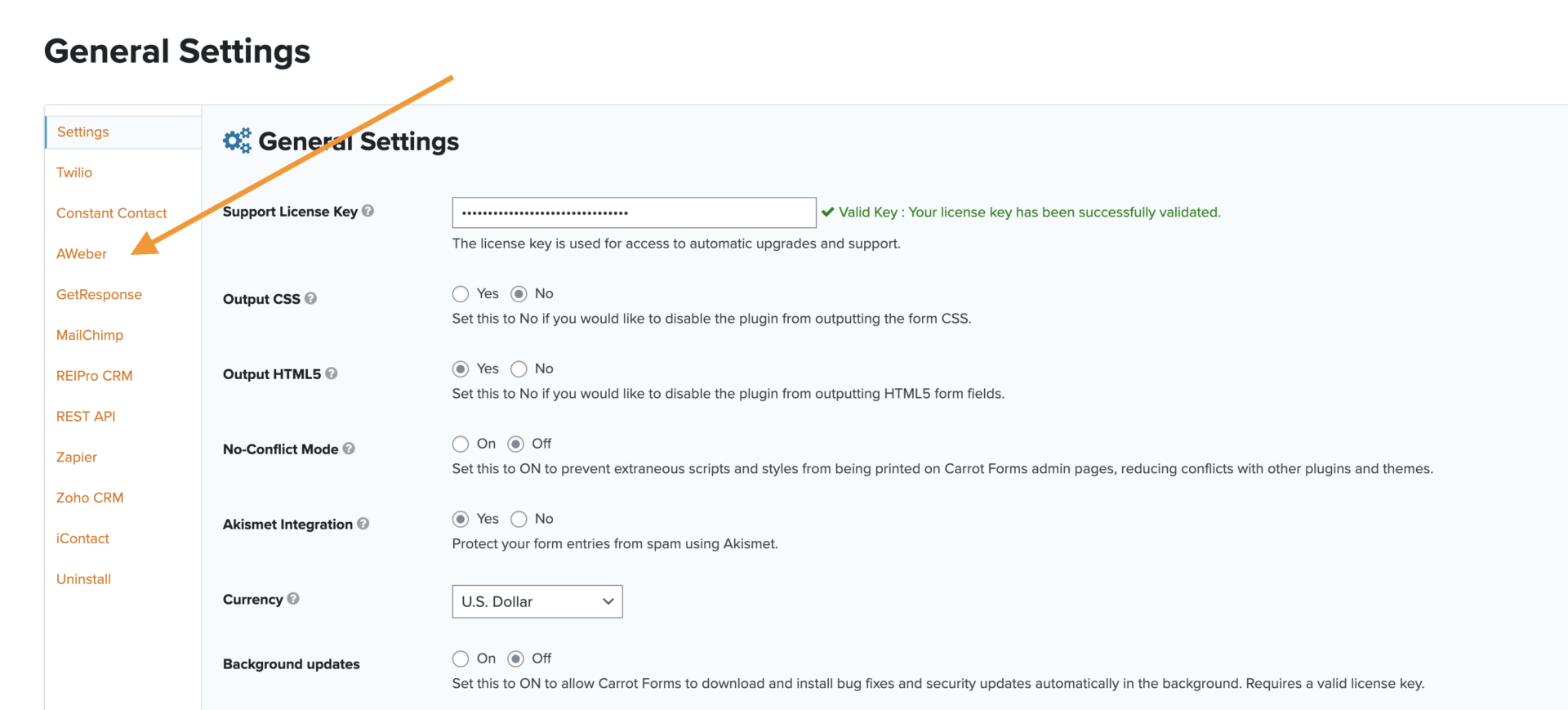
    If you use a system like Aweber (the email marketing system we use) you’ll want your lead pages to integrate for free with Aweber. Carrot will let you use your Aweber forms, MailChimp forms, or our custom form system on your Lead Pages… and it’s crazy easy.

    Carrot aweber integration

    How To Get Your Own Real Estate Landing Pages For Your Website

    I just went over what a Lead Page is (or squeeze page), why they work for real estate investing businesses, what good ones look like, and 3 options on getting your real estate investing lead page up and online.

    So, what do you do now?

    First, if you don’t have a Lead Page and you’re a wholesaler in real estate… you NEED ONE.  I’ve personally built very targeted cash buyers lists well over 500 buyers 100% online via a squeeze page… it works really well and you’re essentially leaving money on the table if you’re not using them.

    Next, decide your budget, skills, and even more important… how valuable your own time is worth.  People try to save money by hiring things like this out cheap (thinking any web guy will know how to create a landing page that works) or they try to learn it all themselves in the name of “saving money”.

    If you don’t already know HTML (if you don’t know what HTML is, I’d highly suggest you don’t do it yourself) then you’re going to be investing a lot of your own time and energy that you should be spending actually finding deals and making offers.

    In the time you learn HTML and hack away at things yourself you could have potentially done a deal that pays you $5k – $20k (which would more than pay for a solid lead page system).

    Usually, the option that makes the most sense is to piggyback on a lead page system that already works and that you can have full control over whether you know HTML or not.  Of course, we’re pretty darn bias to our own real estate investor website lead generation system… you should check it out and see if it’s right for you.  But, there are other systems out there too that you may look at.